Ania Walwicz (1951–2020), the poet and writer, in horse: a psychodramatic enactment of a fairytale, her 2016 doctoral thesis for Deakin University, writes an evocation more vivid than Roland Barthes’ of the experience of being the subject of a portrait, in this case with Naomi Herzog behind the camera…
Naomi Herzog takes photos of me. I don’t know how this will turn out. I will go to her house. No, l will not go to her house. No, I will go to her house. The plans change. She shifts. She goes away. I practice putting on my black beard. I am the Russian tsar. I am my grandfather Enoch. I am grandfather Panafucy. I am Fyodor Dostoyevski in the short story class and the party, the student party where we dress as famous authors for me. I have a collection of masks. I wear them at the theatre. I put me on. Who will I be next. The mask speaks now. Gerry Gee, the doll speaks the words of the ventriloquist. Who am I now? I don’t know and still don’t know. Naomi talks to me on Friday. Naomi takes photos of me. I perform now. When someone looks at what I do. When someone talks to me. Who is the authentic self now? Jean says that I look like a marionette. I am a puppet doll, une poupée, pulled by strings from above. I move awkwardly now. Jumping, leaping, jack in the box. Each movement after another, unforseen, unpremeditated, improvised like leaping music. Something comes out of this now. She said neither you or I knew what would happen and it happens to me. The photos join together in a slide show fast or not so fast or slow, very slow. There is a sequence here. The mask is a pretence. The beard is thick and fluffy. The lady with a beard or my grandfather coming out of me. He comes out of me. The spirit photo of Madame Blavatski. Ectoplasm, the spirit of the dead. My grandfather dances in me. Who am I now. I am the terrible Russian tsar with the black beard on me. I am the Bluebeard, Barbe Bleu – the evil man who speaks here and peeks here. I pretend and pretend, I am the great pretender and then I take off the mask to be what I am. What am I? I buy the moustache of Salvador Dali. My antennae. I know a shop that sells big wings of angel wings now. The wings are made of white bird feathers. The wings of the sailor angels of Jean Paul Gaultier. I put on my fetish show here. Boots of birdfeathers break into flight. Tight shiny rubber coat and pvc trousers with my fur hat on my head. I Ania Vanya cover my cover and uncover plunge over and under, deflect now signify and multiply meanings now. The symbolic meaning grows and grows bigger and large and larger. It ferments now. I stand in a red courtyard and walk up and walk down stairs, the great “Stairway to heaven” now of Mister Zigfield and down an and down in “Sunset Boulevard” where I Gloria Swanston take my last shot and bow and everyone looks at me now. I am the famous actress and I am evil man now. All at once and all at the same time. One thing enfolds another. I make a film now. l x-ray me. I princess now want to marry but won’t have me I tsar nasty old tsar with beard a want to marry princess but she won’t have me I vanya want to marry ania but she won’t have me I want to marry now but I won’t have me I ania want to marry me but I won’t have me oh what’s the matter now oh what’s the matter with me oh dear oh dear oh dear I tell naomi now that I don’t want me I nasty old tsar Russian king want to marry me now but no princess says no now oh please but no now and no no no I want to marry princess but she says no I am old and ugly oh please she says no to me I say no to me I am old and ugly now I am nasty old russian tsar oh dear oh me dear dar dear dar dar dar no neyt no nie nigdy nigdy never never or ever will you marry me but I say no I get bigger little one if you were bigger I would marry me but I never grow now oh so bad sad now angry old lady little little now little old me oh dear old me will you marry never ever Russian tsar dyes my hair but I can’t marry or ever what’s wrong now oh every every thing now every thing is wrong oh oh oh oh oh oh oh oh oh oh oh oh oh oh oh oh I cry now I wish I could cry now I will cry and cry and cry I cry now at last I cry I can cry…
She quotes Jung: “The self is a mysterious phenomenon that arises spontaneously in the ‘psyche’ that confronts the subject, independent of him …”
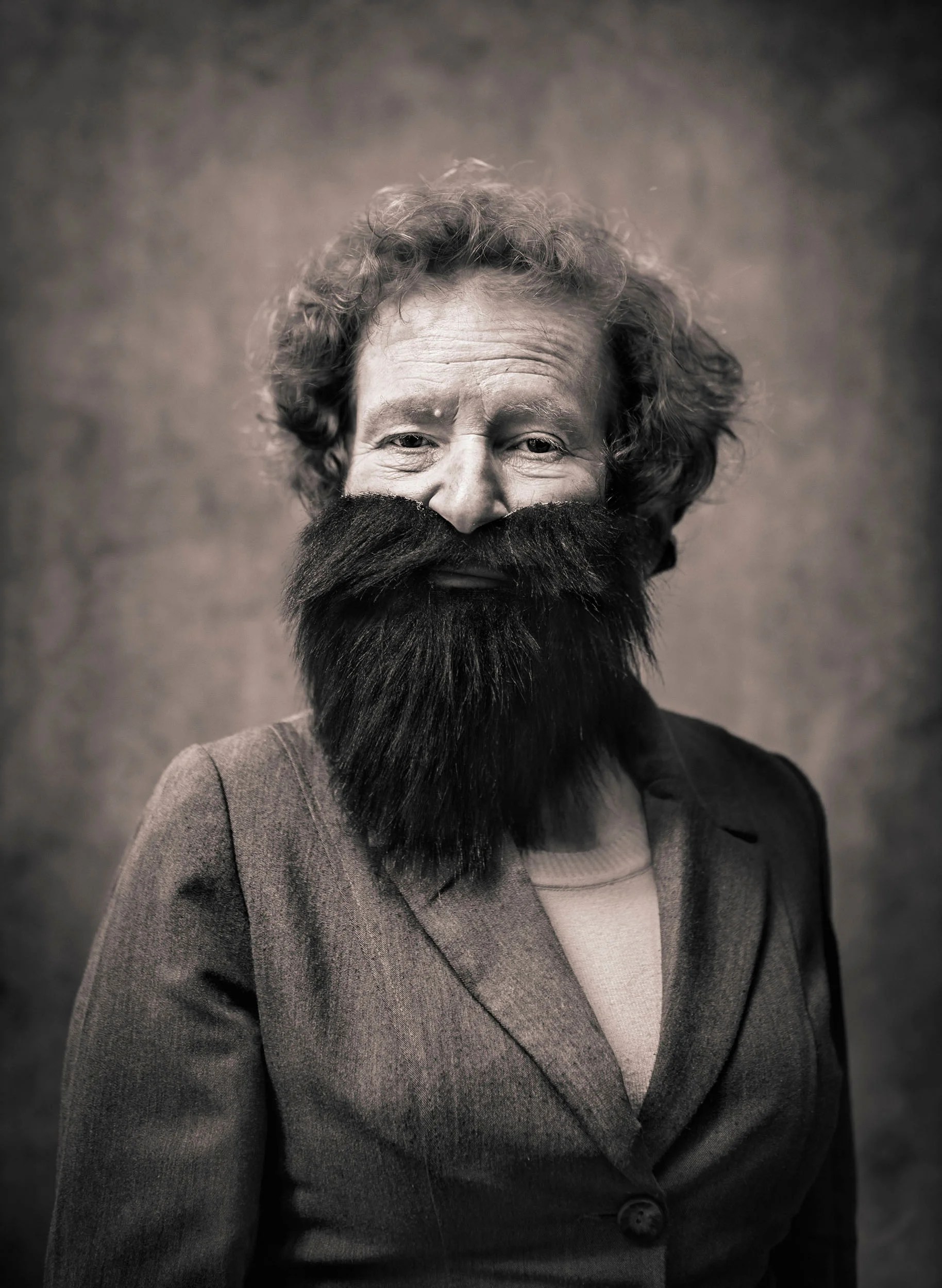
The series of portraits of the poet and writer Ania Walwicz was shown in the Head On awards and draws on Herzog’s sense of staging and characterisation in portraiture and a particular sensitivity to this literary persona, revealing Herzog’s capacity to form a visual vocabulary for another artist’s voice.
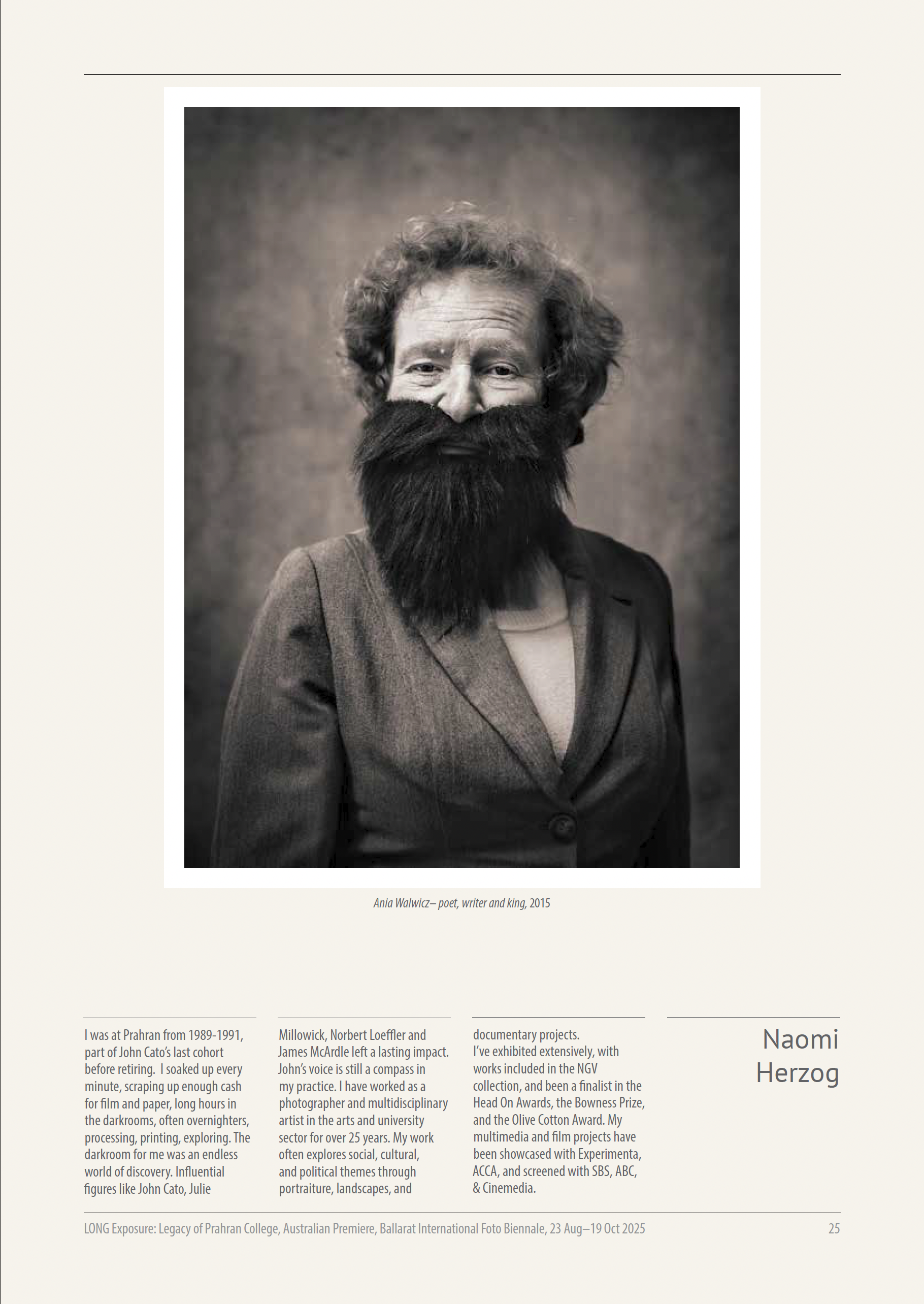
This is one of the portraits that Naomi presents as part of Long Exposure: The Legacy of Prahran College at the Ballarat International Foto Biennale 23 August—19 October 2025 at the Miners Tavern, 120 Lydiard Street.
At the same Festival she appears as a finalist in the Martin Kantor Portrait Prize with a portrait of environmental photographer Harry Nankin whose work she admires.
He talked about various ideas he was working on and I was given a glimpse into some of the work in his studio. Using one of his images as a backdrop, I worked with the strong lines of Harry’s profile to capture this portrait.’ Naomi Herzog (in The Guardian)

Naomi Herzog has been an aerialist who knows the risk and rigour of bodily performance, and here Nankin’s body, on first impression impassive, acts on the space around him. What appears at a glance to be a smile is found to be a determined setting of the lips. His aquiline profile impresses a classical stillness that seems to quell the turbulence of the image behind, while Nankin’s wiry hair irresistibly invites a curious touch which then viscerally, and across the entire image, enlivens and activates the textures which are all the product of carefully controlled light, focus, exposure and placement.
Herzog became an educator who built technical systems and designed conceptual curricula for future makers, while her own work — intimate documentary photographs, layered multimedia pieces and staged portraits — has generously contributed images of other creatives through community arts and Australian public television
At Prahran College from 1989-1991 Naomi was amongst John Cato’s last cohort before his retirement, a period coinciding with the digital shift and the photography department’s absorption in the Victorian College of the Arts.
Cato’s and other lecturers’ emphasis on technical tonal finesse in print-craft and on photography as sustained inquiry are evident in Herzog’s 24 years at RMIT as a course coordinator and her design of colour-managed digital print-studios in her as multimedia course coordinator/lecturer, and latterly in senior academic specialist positions.
I soaked up every minute, scraping up enough cash for film and paper, long hours in the darkrooms, often overnighters, processing, printing, exploring an endless world of discovery. John’s voice is still a compass in my practice. — Naomi Herzog.
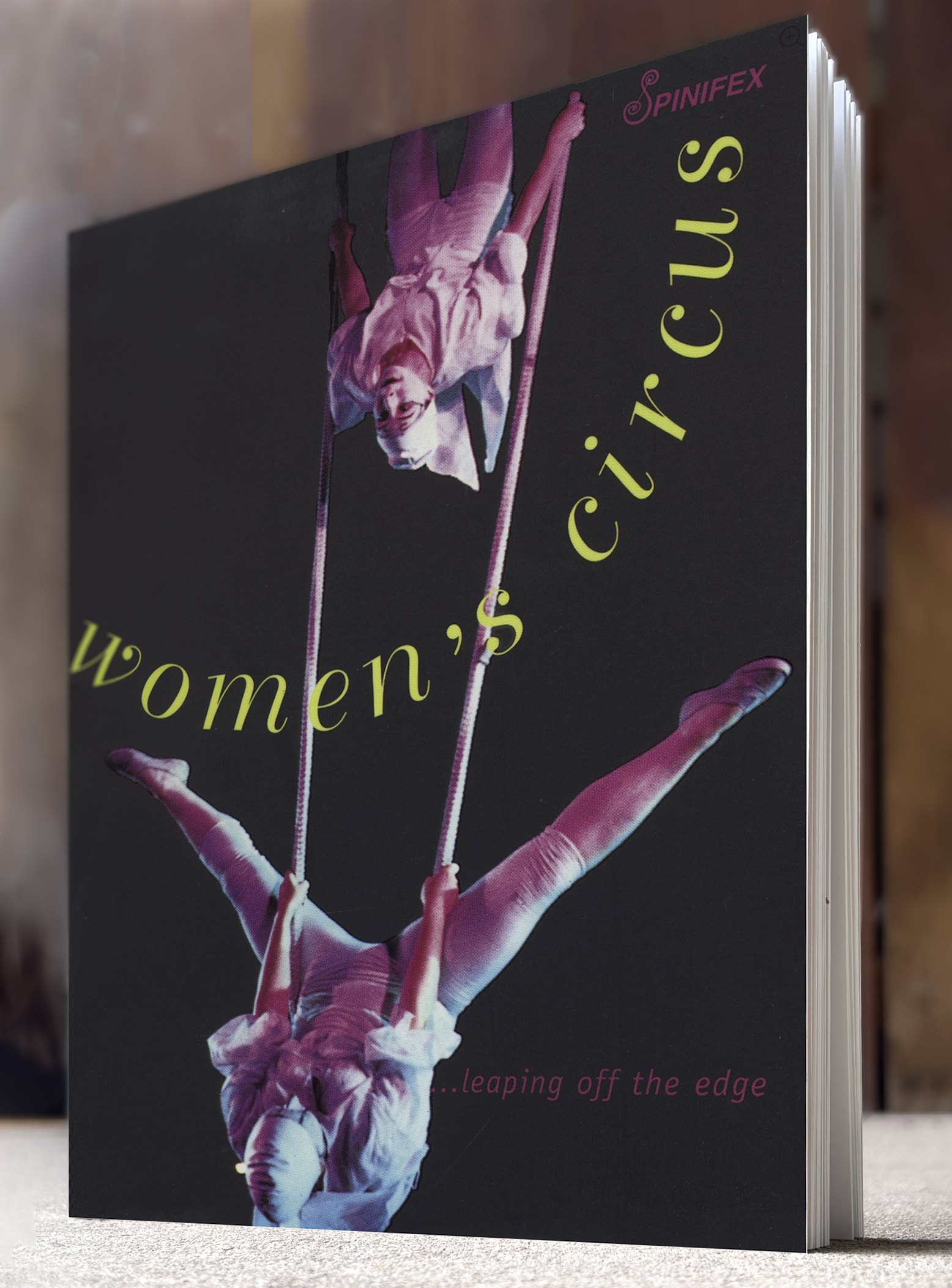
After formal photographic study and early assistant work with photographer Ponch Hawkes, Herzog made a leap sideways: she “ran away and joined the circus”—taking camera with her…
“For me photography began as an art of the mind; the circus became an art of the body.” — Naomi Herzog.
Between 1993 and 1995 she trained and performed as an aerialist and acrobat with the Women’s Circus, a community arts company that combined physical theatre with political storytelling and that toured internationally in the 1990s. The experience was far from a sideline. Herzog not only performed; she photographed the company, created images that document its rituals and, in 1995, directed a performance dealing with Aboriginal deaths in custody as part of the show Leaping the Wire.
Images and writing from this period appear in the Women’s Circus book Leaping Off the Edge (1997) — a record that places Herzog’s photographic work at the intersection of activism, community practice and visual testimony. That time in the circus was not a detour but an expansion: it brought movement, public ritual and the language of the body into a practice that had begun in the darkroom
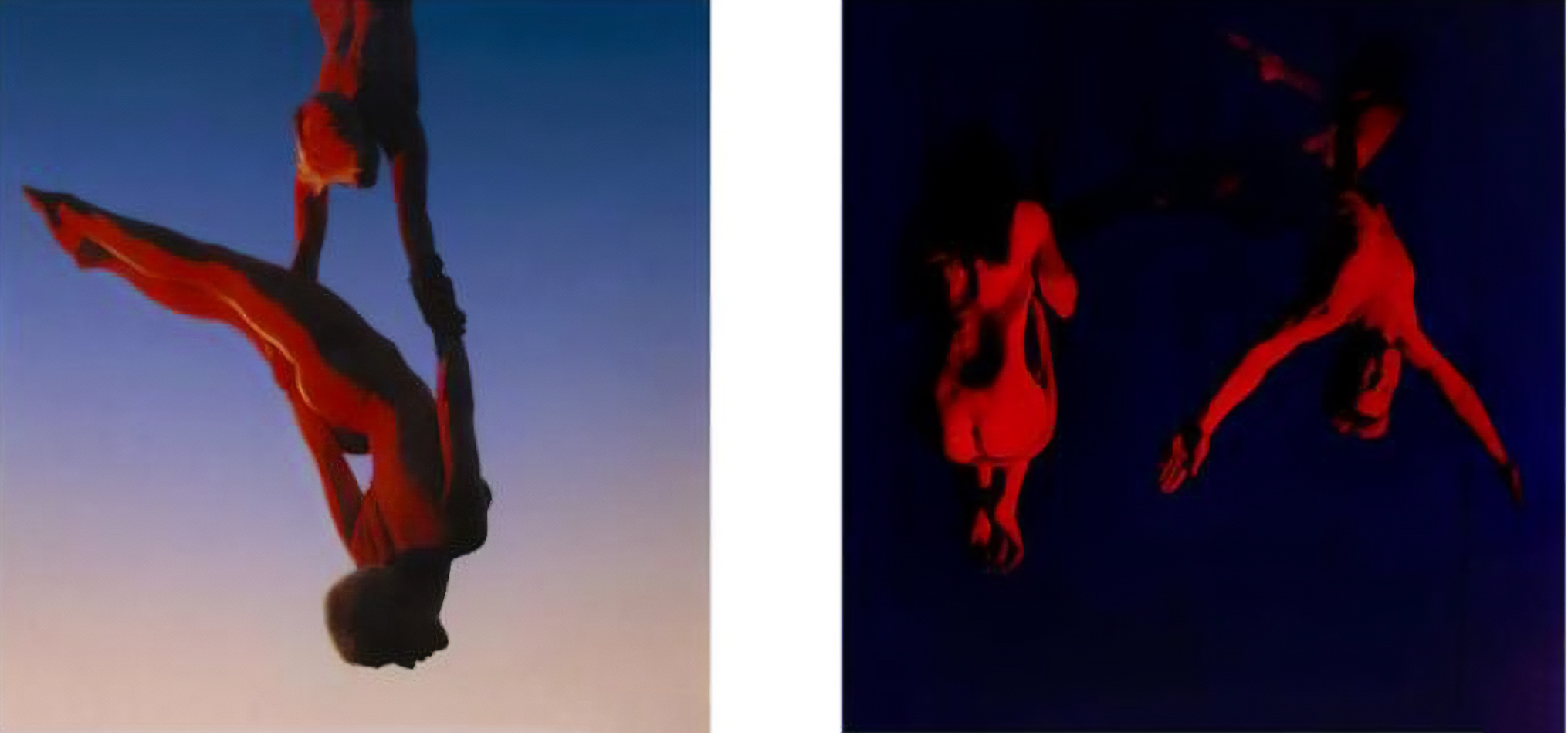
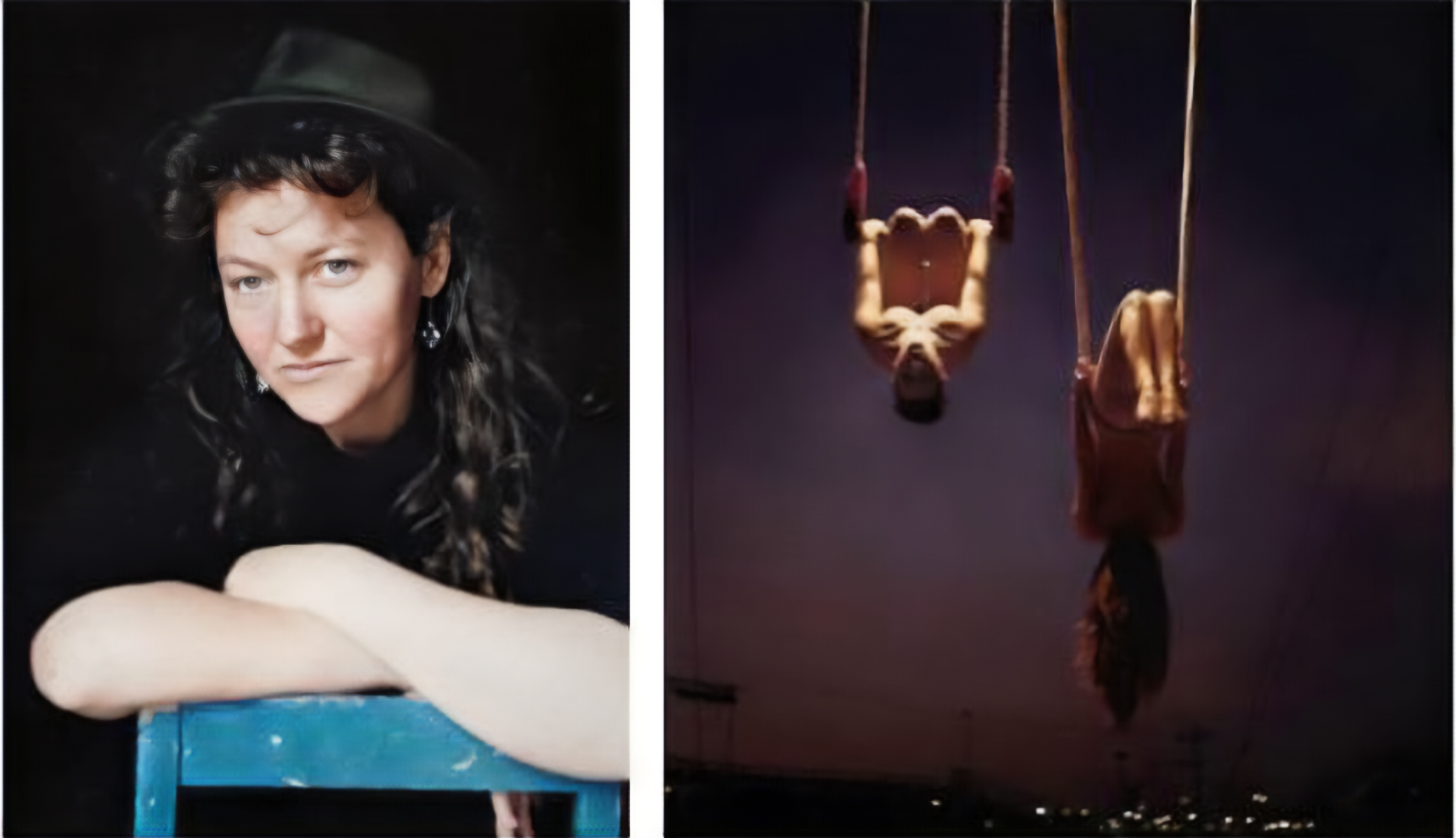
Working together in a company to create physical theatre was a formative experience and has been of enormous value in many working projects and environments that were to follow.” — Naomi Herzog

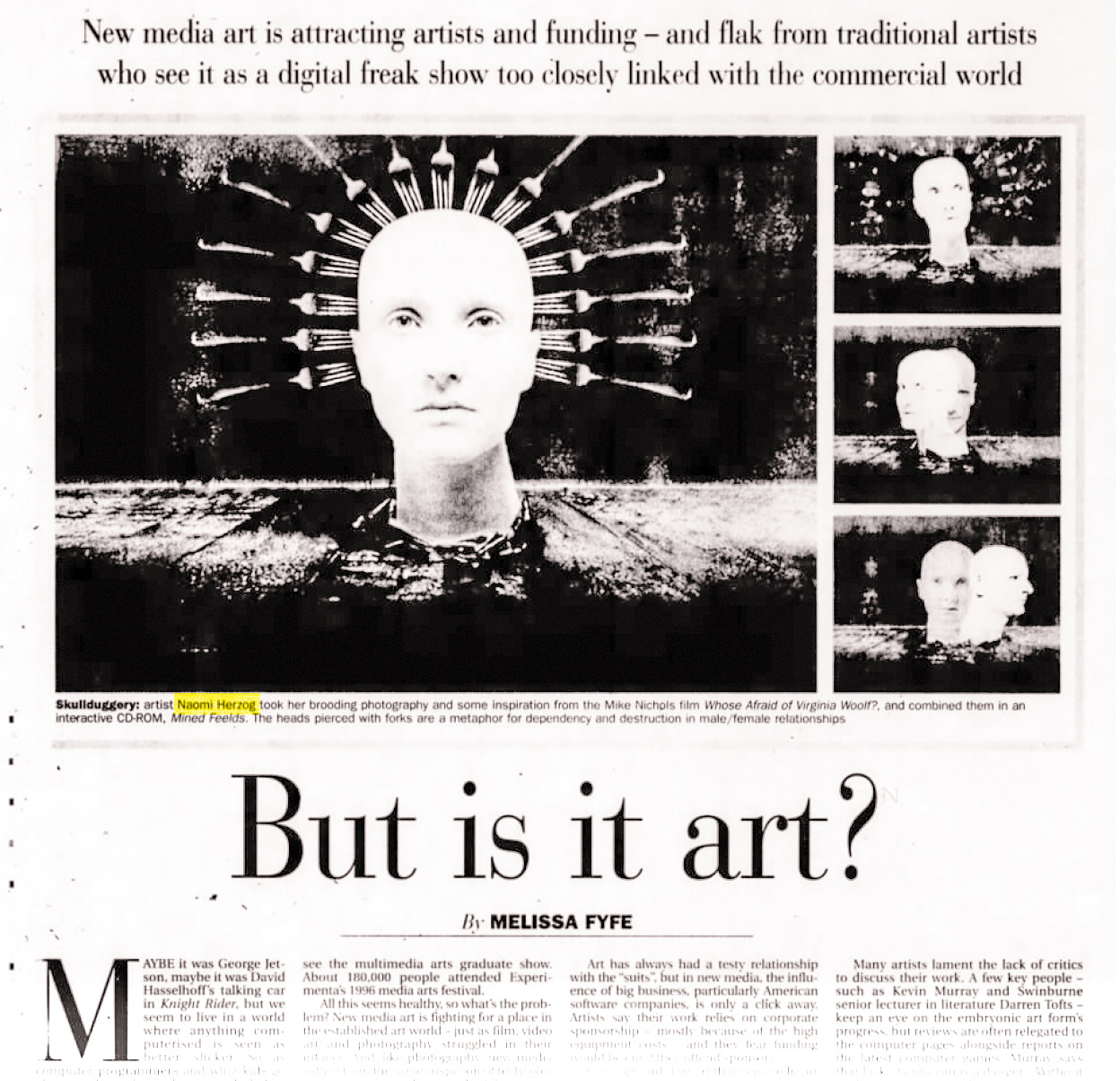

During her Advanced Diploma, Electronic Design and Interactive Media at RMIT University (1995–1996) Naomi became quickly fluent in emergent media, exhibiting such work in the Interact Asia Pacific Multimedia Festival (1997) and producing an interactive work Mined Feelds, which Darren Tofts (Realtime. Issue 22, Dec-Jan 1997-1998, p.21) considered “a brooding anatomy of mind and memory [inviting] the user to work through a range of dungeon-like spaces, prompted by a macabre interface of severed heads.” It was shown at The Australian Centre for Contemporary Art, Melbourne in 1998:
“The main playing field, the ‘cyber-zone’, is the head, the door to all perceptive and interactive pathways. The eyes, ears and mouth appear in mechanical restraints, a comment on how our perceptions are prescribed by nature/nurture. By clicking on the eyes we are in post-production, re-editing a discrete climatic [sic] sequence from the film (Who’s Afraid of Virginia Woolf?), where we hear Martha telling a humiliating story about George while we see him fetching a gun and aiming it at her. To activate each vignette we must turn images of the male and female heads on screen, reminding us of the plurality and non-exclusivity of perception. When we inadvertently re-edit, we rupture the dramatic crescendo that pre-ordains the narrative closure, and re-contextualise the sequence’s meaning.” Amanda King, ACCA Press Release

While maintaining a freelance photographic practice, and still documenting the work of performance groups, Naomi took on digital-media roles (senior designer at Acumen Multimedia, 1996–2001) and produced program IDs, countdown sequences and experimental pieces for early SBS and Cinemedia projects compositing layered imagery and bringing still photography into motion and interactivity — such facility and expertise made her a natural fit for the multimedia curricula she later taught.
From the late 1990s onward Herzog committed herself to higher education, with considerable influence. She taught sessionally at RMIT and Swinburne before becoming Lecturer and Coordinator in RMIT’s multimedia and photo-imaging programs (2002 onward). Over nearly two decades Herzog built curriculum in photographic theory, advanced editing, compositing, colour and fine-art printing; she established print facilities and a colour-managed digital workflow so students could produce archival exhibition prints. These institutional achievements — technical, pedagogical and organisational — are a direct translation of Prahran’s insistence on conceptualisation and craft into contemporary university practice. By the 2010s and into the 2020s Herzog was a Learning Management System champion, Senior Advisor in Academic Workforce Development, and (from Aug 2022) Senior Educational Practice Specialist at RMIT, working on higher-level pedagogical strategy. Her influence is structural: she redesigned how students make and present work.
“I set up print facilities and a colour-managed workflow so students could produce work at archival exhibition standards.” — Naomi Herzog
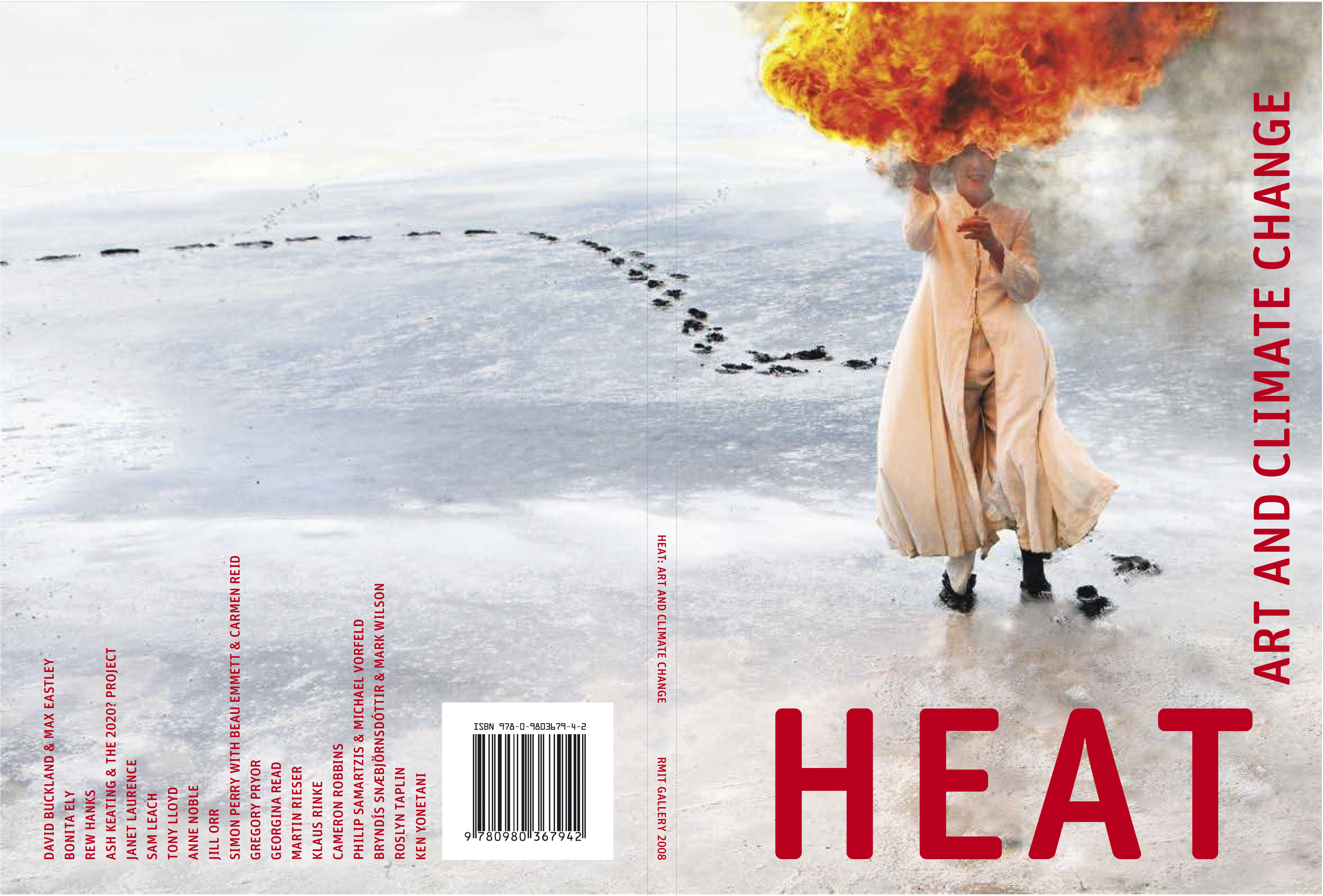
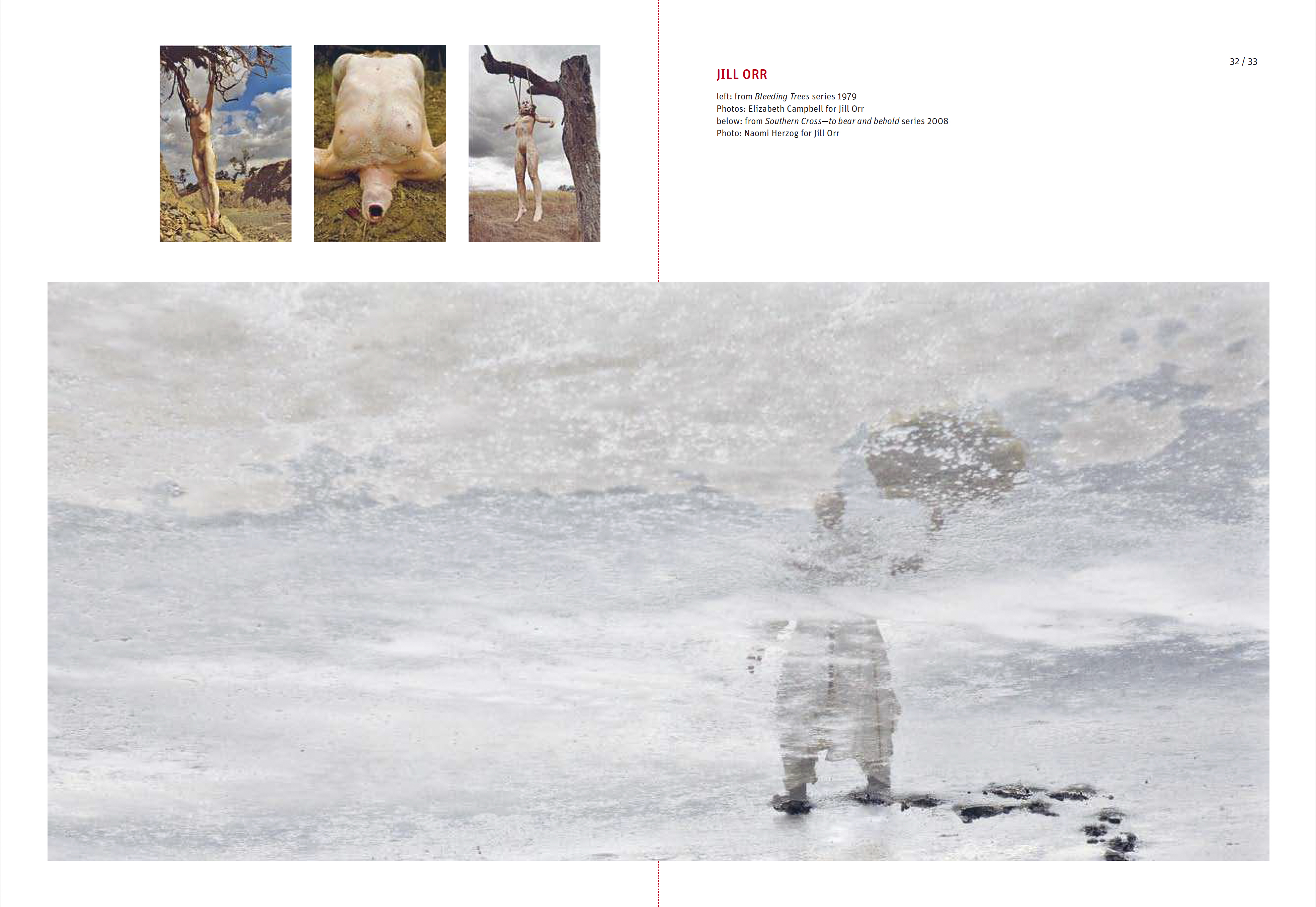
Alongside institutional work, Herzog has continued a quietly sustained practice as a portraitist and collaborator. Her photographic collaborations with performance artist Jill Orr are held in national institutions and were included in HEAT: Art and Climate Change at RMIT Gallery, Melbourne, in 2008, an international exhibition that was the first of its kind in Australia, showing contemporary artists’ responses to the issue of global climate change. The work was also represented (with Harry Nankin’s) in Stormy Weather: Contemporary Landscape Photography over 2011-2012, at the Ian Potter Centre: NGV Australia, Fed Square, then touring to Swan Hill Regional Art Gallery.
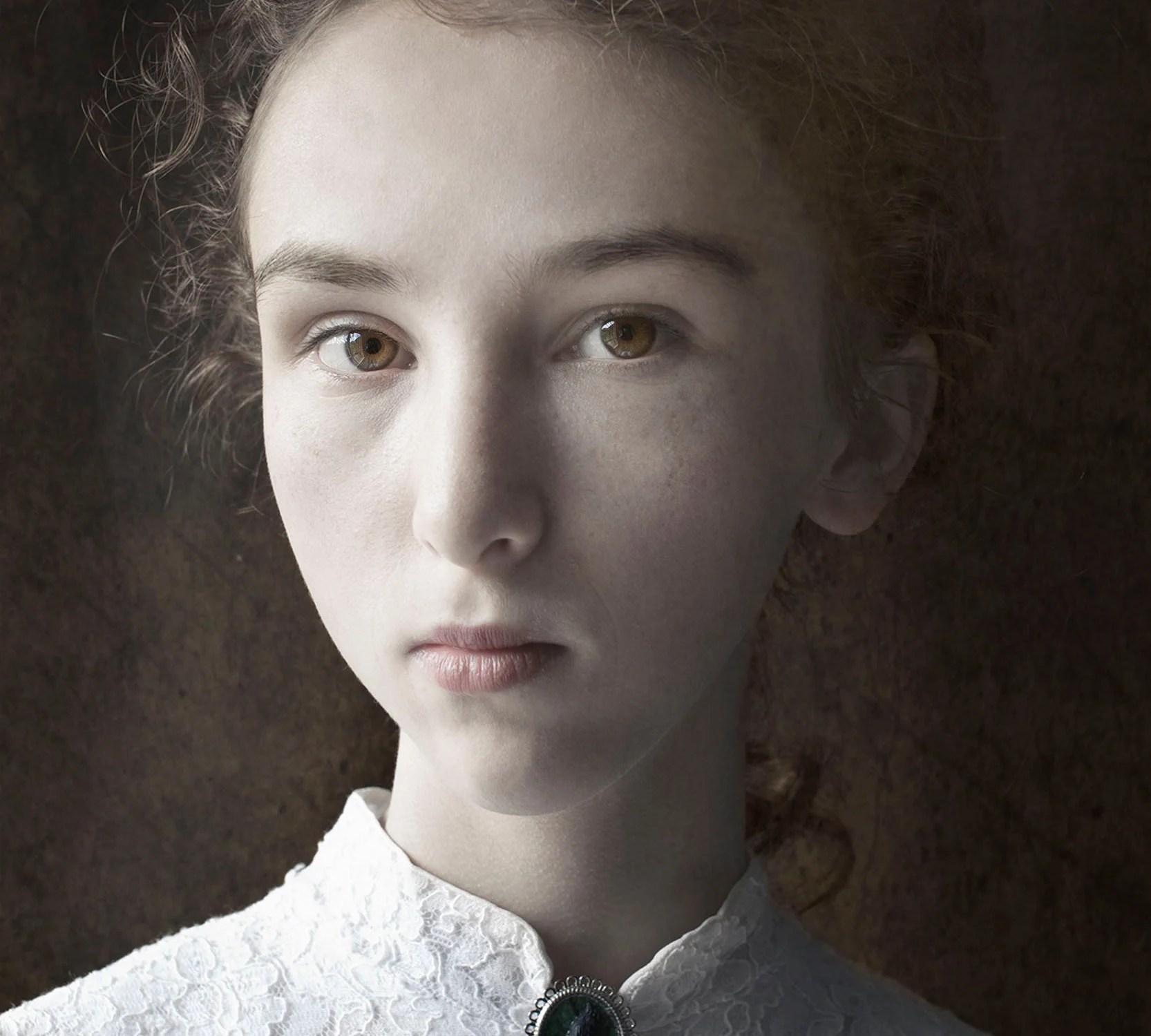
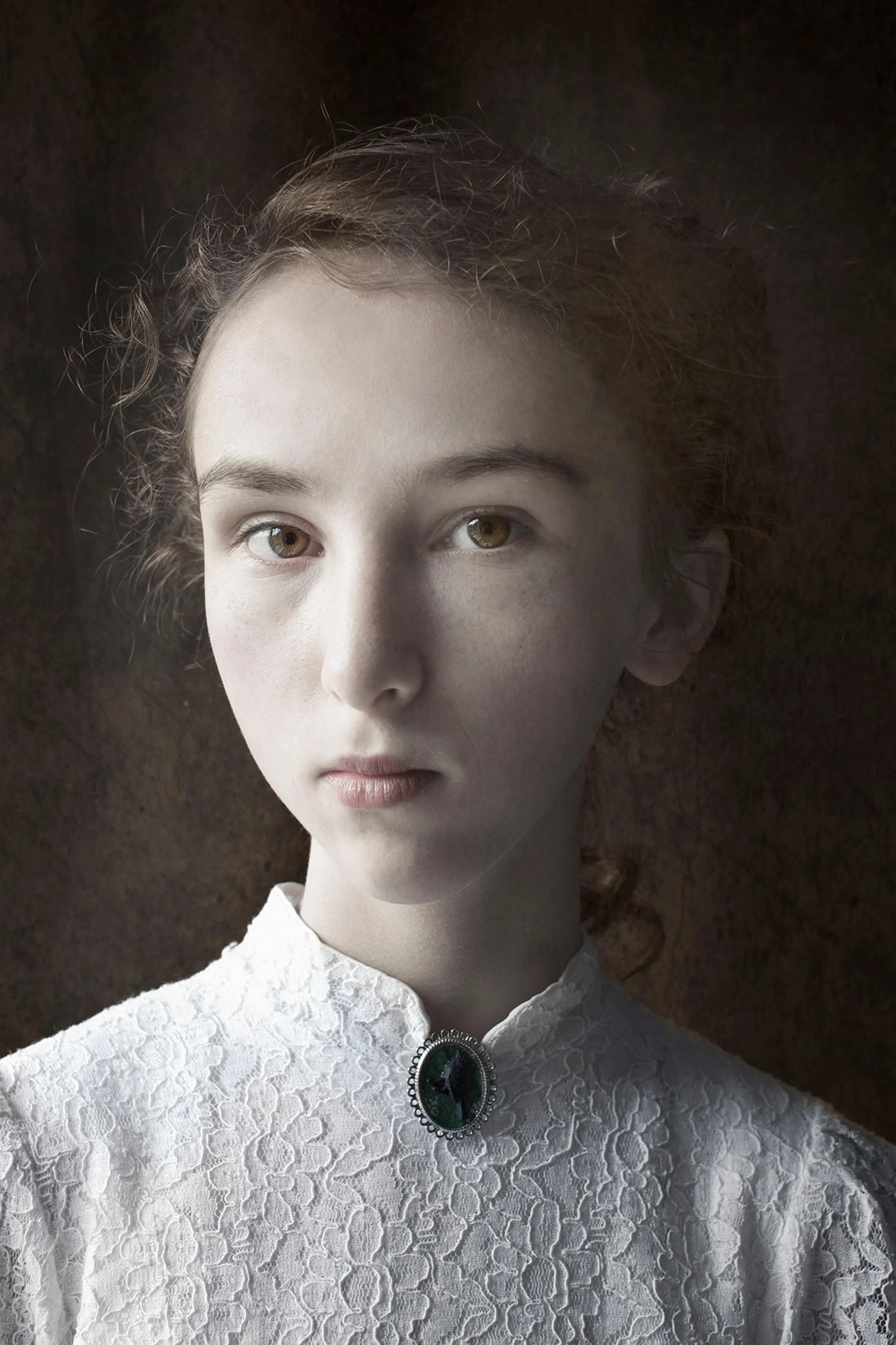
Naomi was also a finalist in the 2011 Olive Cotton Award for Photographic Portraiture, at Tweed River Art Gallery 3 June – 31 July 2011 with this hauntingly direct but delicate depiction of young girlhood, in restrained colour that evokes an antique sepia.
Herzog’s film and digital projects have joined artist-run festivals and institutions, while her documentary portraits and photojournalism feature in projects run by MAP Group for which she served as Vice-President, including among the paste-ups presented on the streets of Castlemaine for the town’s 2019 arts festival.

While it falls within that well established trope of the artist in front of their work, the portrait of sculptor/painter Lynne Edey by Naomi is so descriptive of both. We can easily disregard lumps and wrinkles and the slightly misaligned sheets of the street-art paste-up presentation to admire the tonal and compositional qualities of this image.

This tiny, wiry person has formidable strength that has enabled her to pursue her sculpture career despite a biography that would frustrate those less determined, and her sweet but persuasive manner has influenced this image. Herzog paid Lynne two visits, first shooting Lynne against her studio wall among her tall cacti, but returned at her own insistence to make this more nuanced portrait.
Naomi Herzog’s’s images of community practice, the circus, and staged portraiture form an archive of cultural life in Victoria across the 1990s and 2000s and she concurrently translated them into a mature professional pedagogy.
“My practice moves between the documentary and the staged; between the performance of the body and the craft of the print.” — Naomi Herzog.
 Prahran Photography
One thought on “The alumni: Naomi Herzog”