Alumnus Sandra Graham, known also by her married name Irvine, and sometimes as Sandra Irvine-Graham, was born on 31 October 1947 in Casterton, a small town on the Glenelg River not far from the South Australian border.
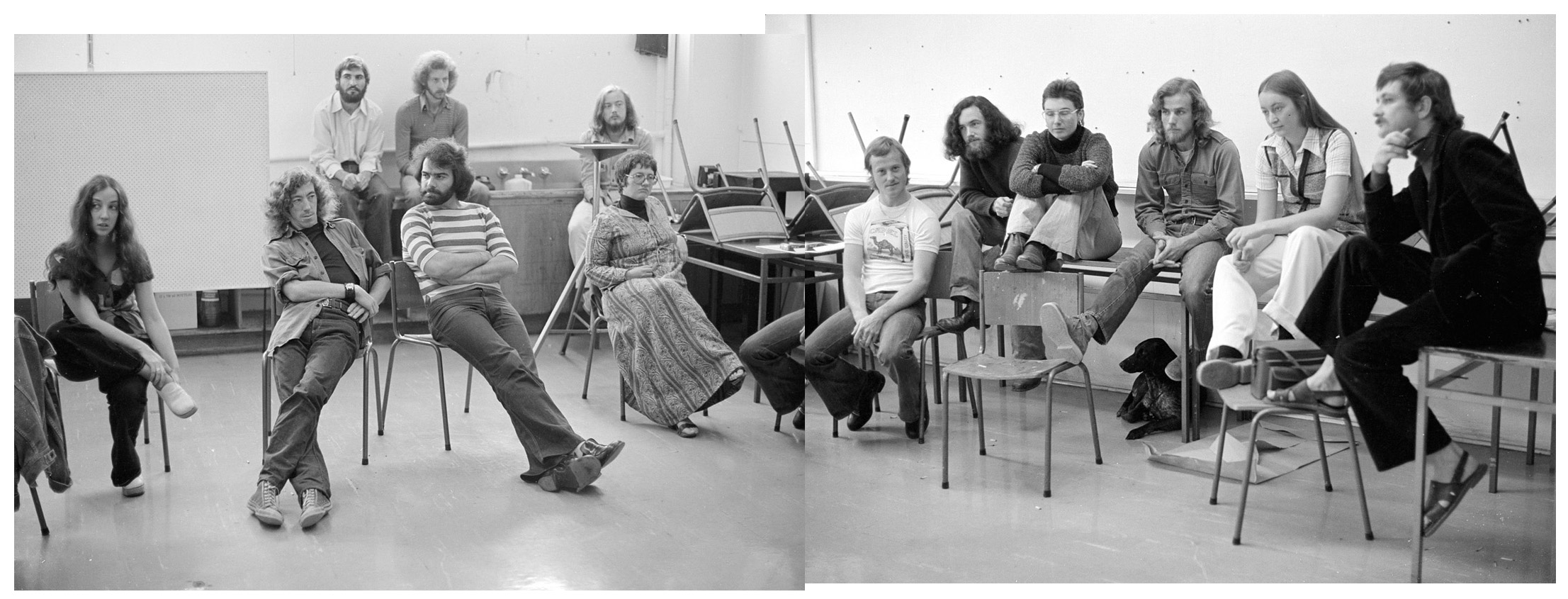
Sandra undertook teacher training and taught for seven years. With her husband Royden ‘Roy’ Irvine she was seconded to set up in 1973 the first alternative school in the secondary system, Brinsley Road Community School (which counts Prahran alumnus Polly Borland among its more famous ex-students). It was an intense experience that broke up their marriage. Roy suffered a breakdown in late 1974, quit the school, travelled then went on to make films and never taught again. He died on 26 April 2024.
Andrew Chapman (1974) Paul Cox (right) with the class of ’74. Sandra Graham at left.
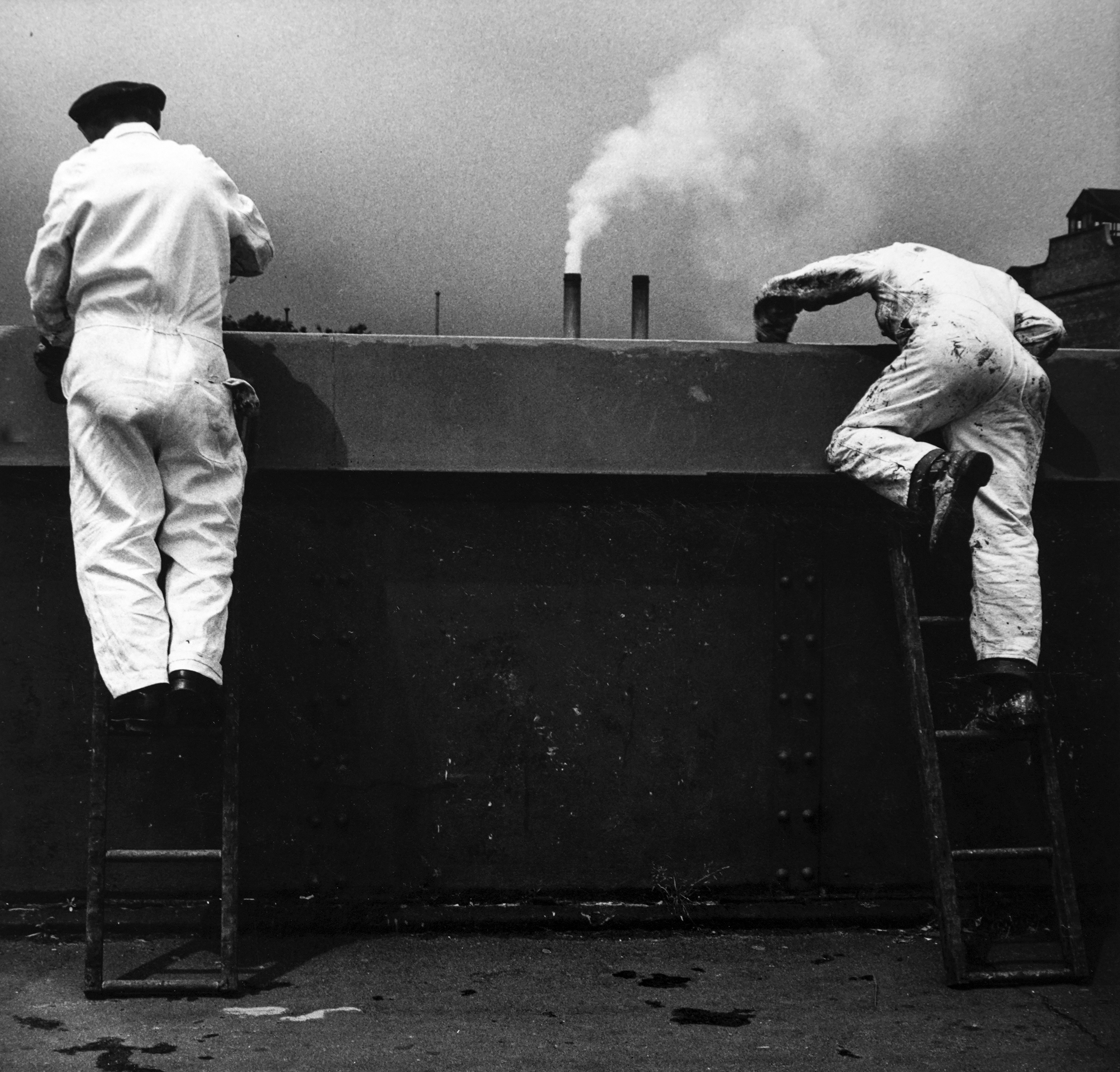
Sandra resigned to enrol in photography at Prahran College in 1974. Her medium-format imagery, by second year in 1975, had developed a distinctively dramatic, metaphysical bent, whether applied to street photography, like this ‘found’ event Backstage which she remembers she shot in diffuse, wan sunlight; “a play on the figure/ ground connection, and tonal relationships. These at times humorous synchronicities were everywhere.”
Sandra Graham (1975) Backstage, Chapel street bridge, Windsor.
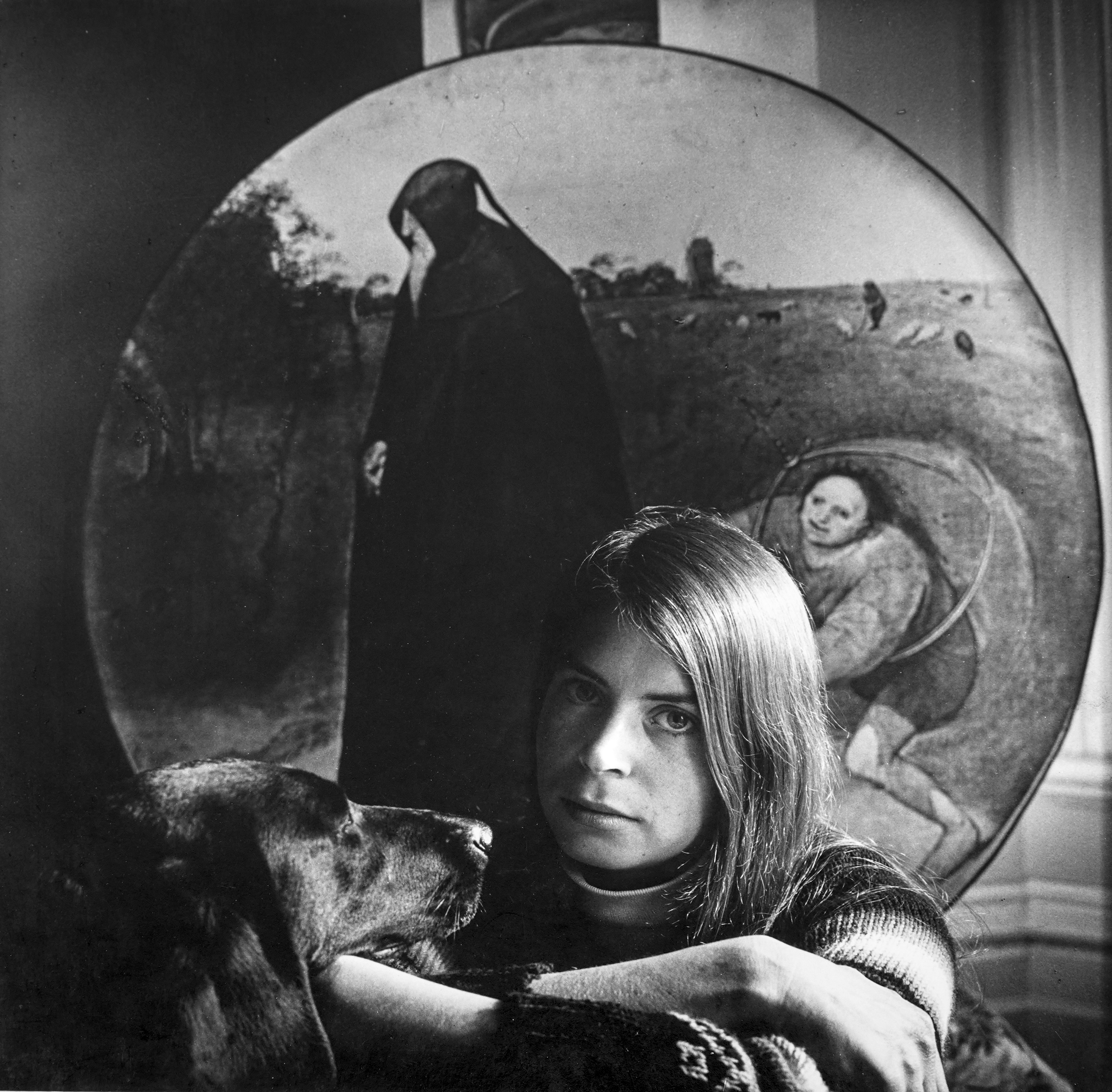
In her empathetic portraits set charged environments, openings in which, whether doors, windows or paintings, provoke an enigmatic narrative that the viewer must complete for themselves;
“I used the visual event from another time in painting history as a background and contrasted it with the very present, the fleeting intimacy of Susie and my then canine pal Ploddy.
“Great artists, painters and sculptors, were an ongoing source of inspiration, as were photographers such as Josef Koudelka, Duane Michals, Edward Weston, Robert Frank, Cartier Bresson, Richard Avedon, Paul Strand, Arnold Newman, Edward Steichen, Imogen Cunningham, Bill Brandt, Cindy Sherman and others…”
Graham Sandra (1975) Susie, Plod n’ Breughel
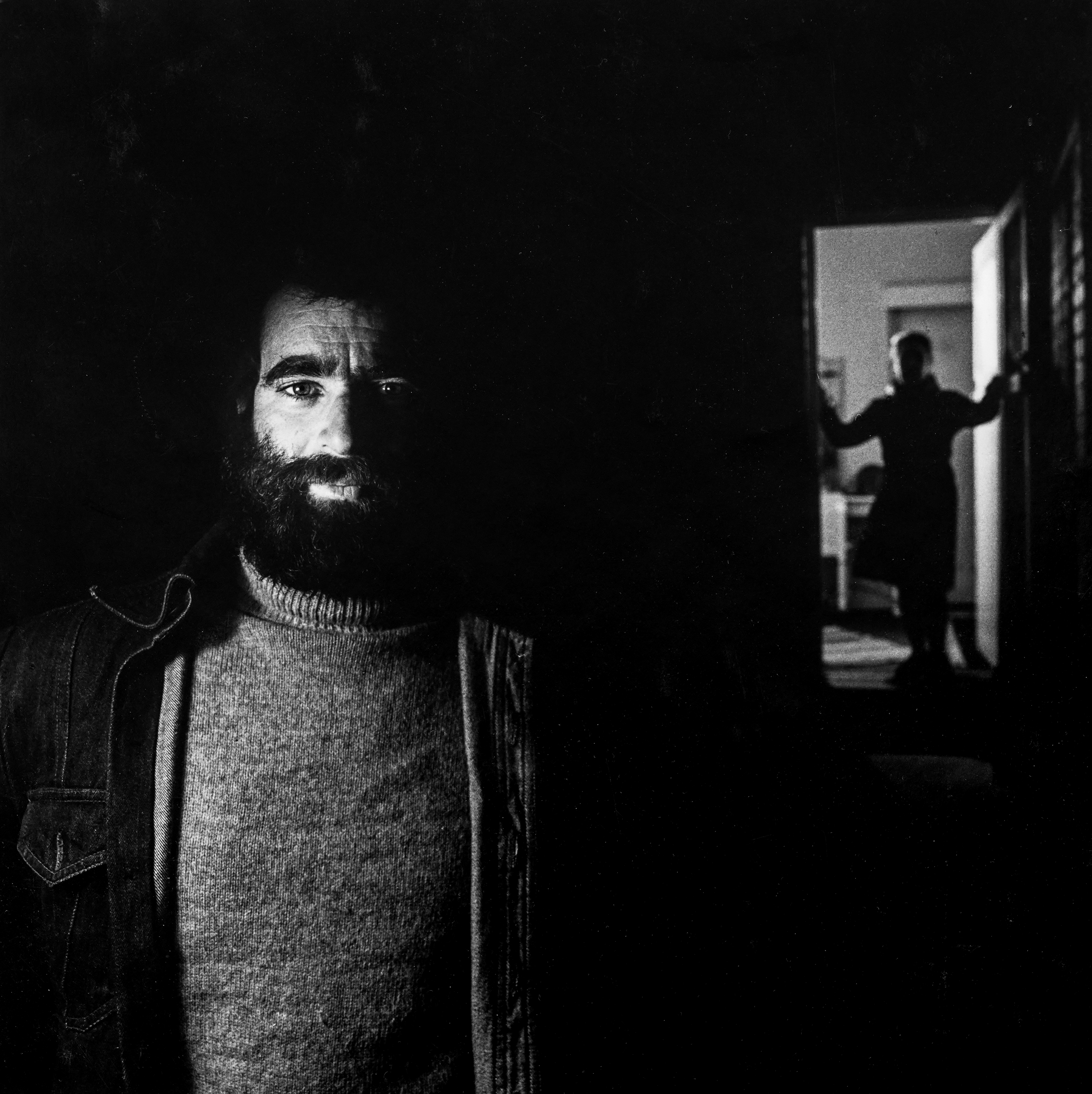
“Using a tungsten floodlight created the silhouetted figure in the background, and another lamp side-lit the subject, Mark, plus a front reflector as fill is a further transition in creating the background in order to tell a story. The figure behind is Mark’s mother.”
Sandra Graham (1975) Mark
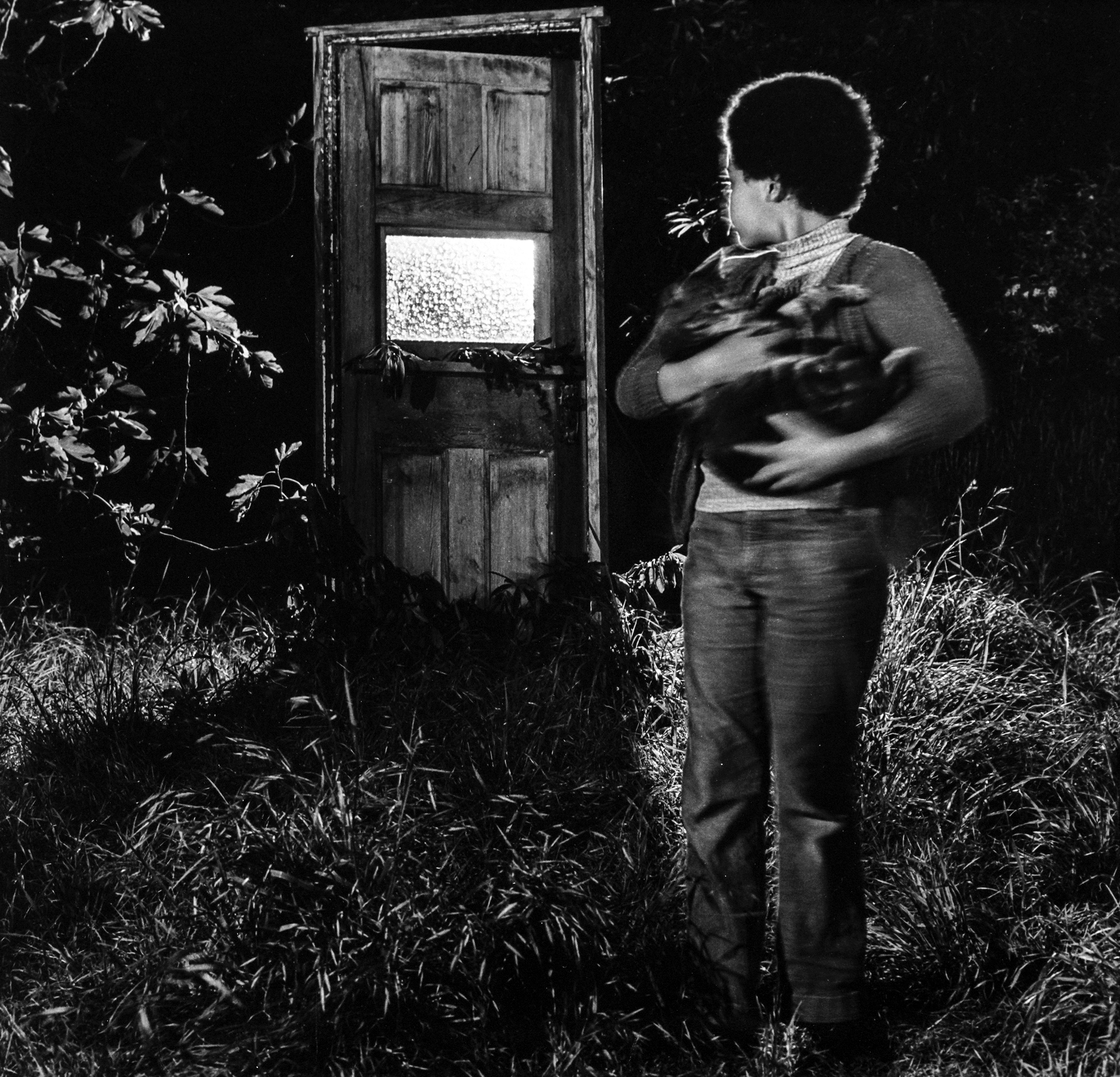
“Daniela & Samura was shot in my front garden Canterbury, Melbourne. A small floodlight behind the door threw the front shadow, and created a rim light around Daniela’s head while another low down created texture on the garden. I projected a diffused light on Daniela. By constructing the lighting as well as the ‘set’, I had achieved my I then interest in the created image, or, “mise e scene” as my photos were categorised when I attended a workshop in Arles, France with Swedish photojournalist Anders Petersen. I was mainly interested in a conceptual photography at that time.”
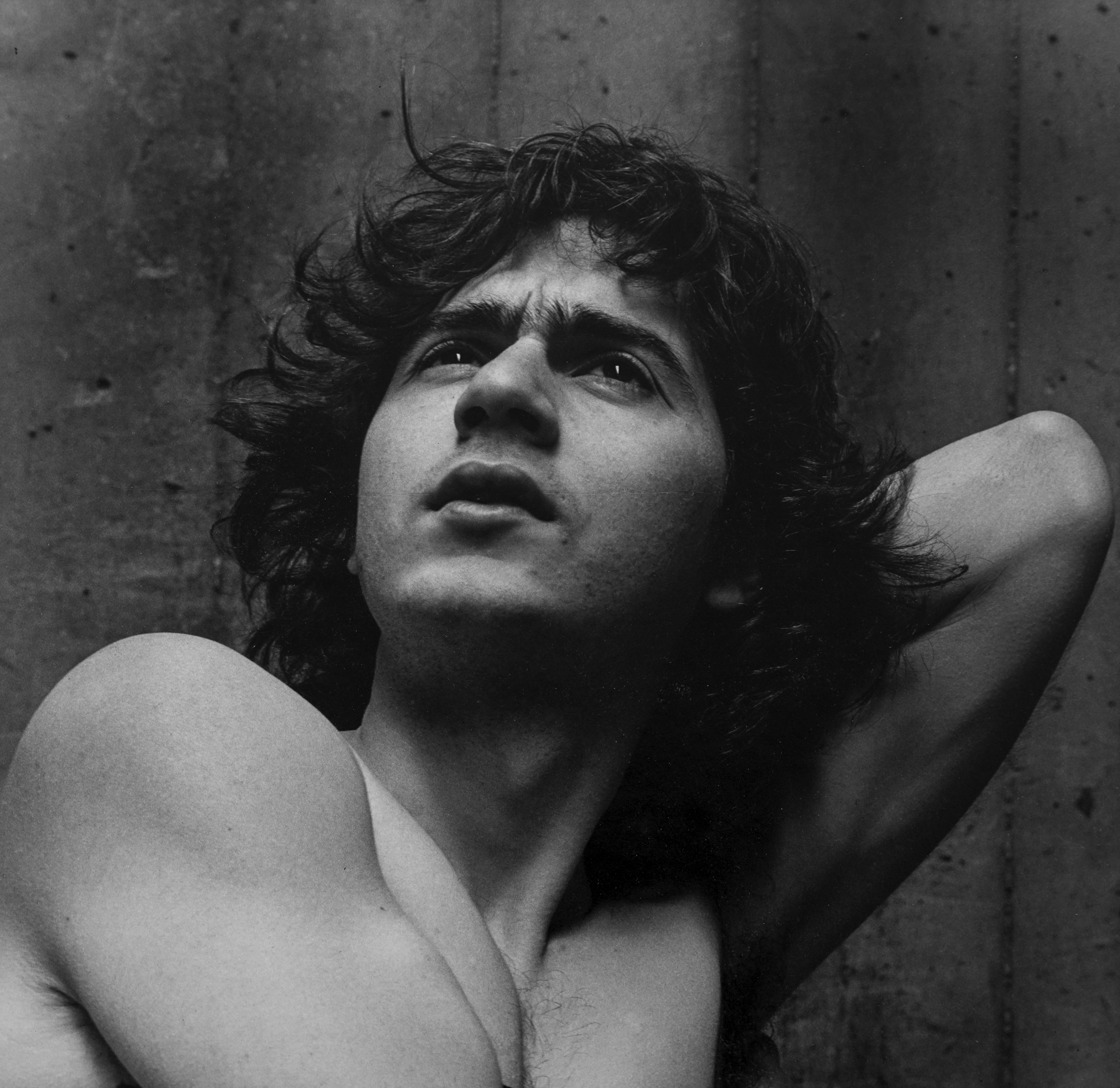
Sandra Graham (1975) Daniela and SamuraiSandra Graham (1975) Youth 1
Sandra remarks that:
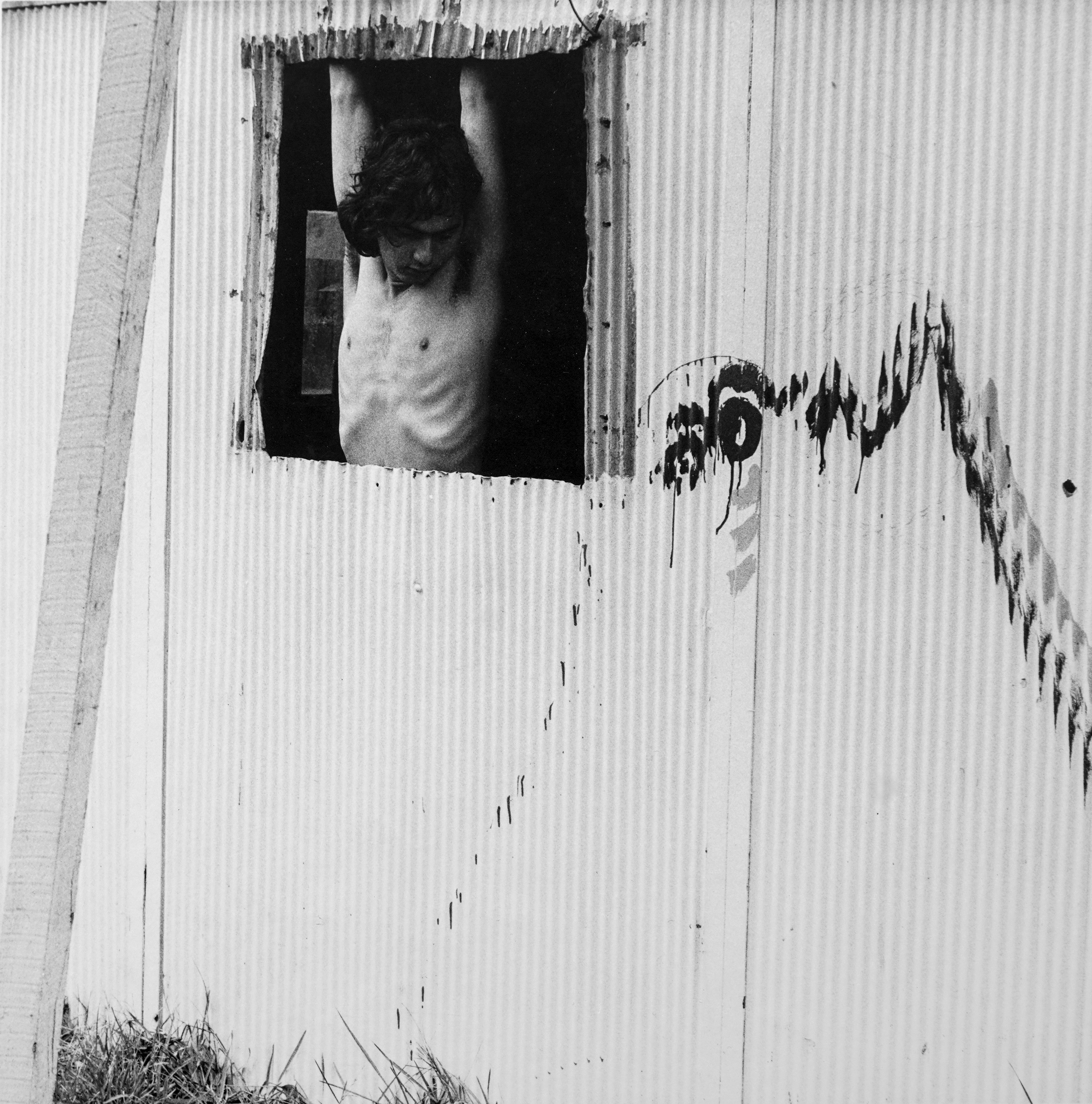
“’Youth’ I was inspired by the drama provided by available light on aged, stained, imperfect locations. The idealised human form is renaissance-inspired, but seen in the context of the present—walls as in Rome, found in Richmond!”
“This image was from a series combining idealised youth with a sense of existential doubt. Archways beneath the train station on Swan Street in Melbourne where shafts of daylight from above added great modelling against stained walls. This was a series exploring body, posture and light.”
Sandra Graham (1975) Youth 2, Richmond
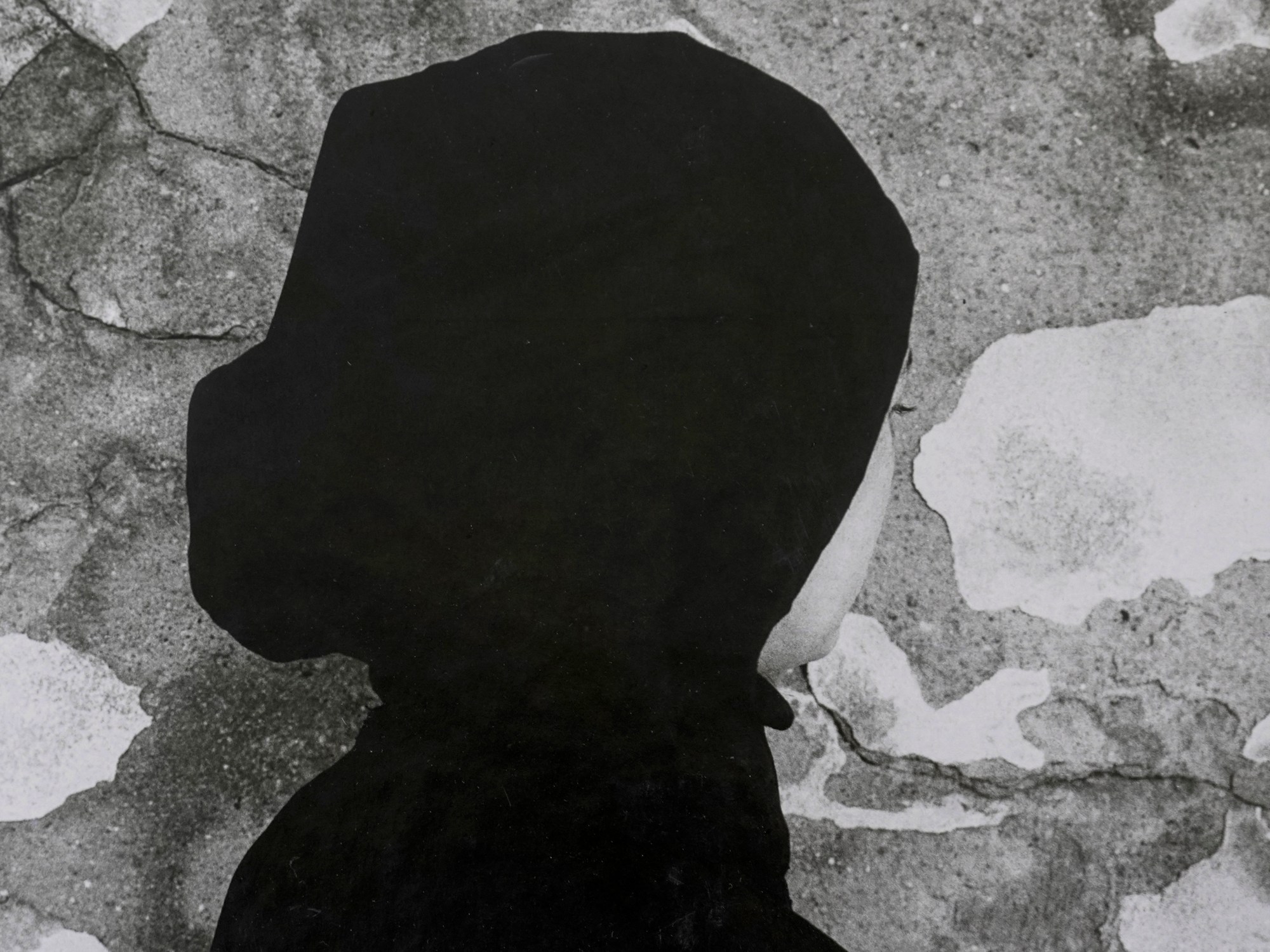
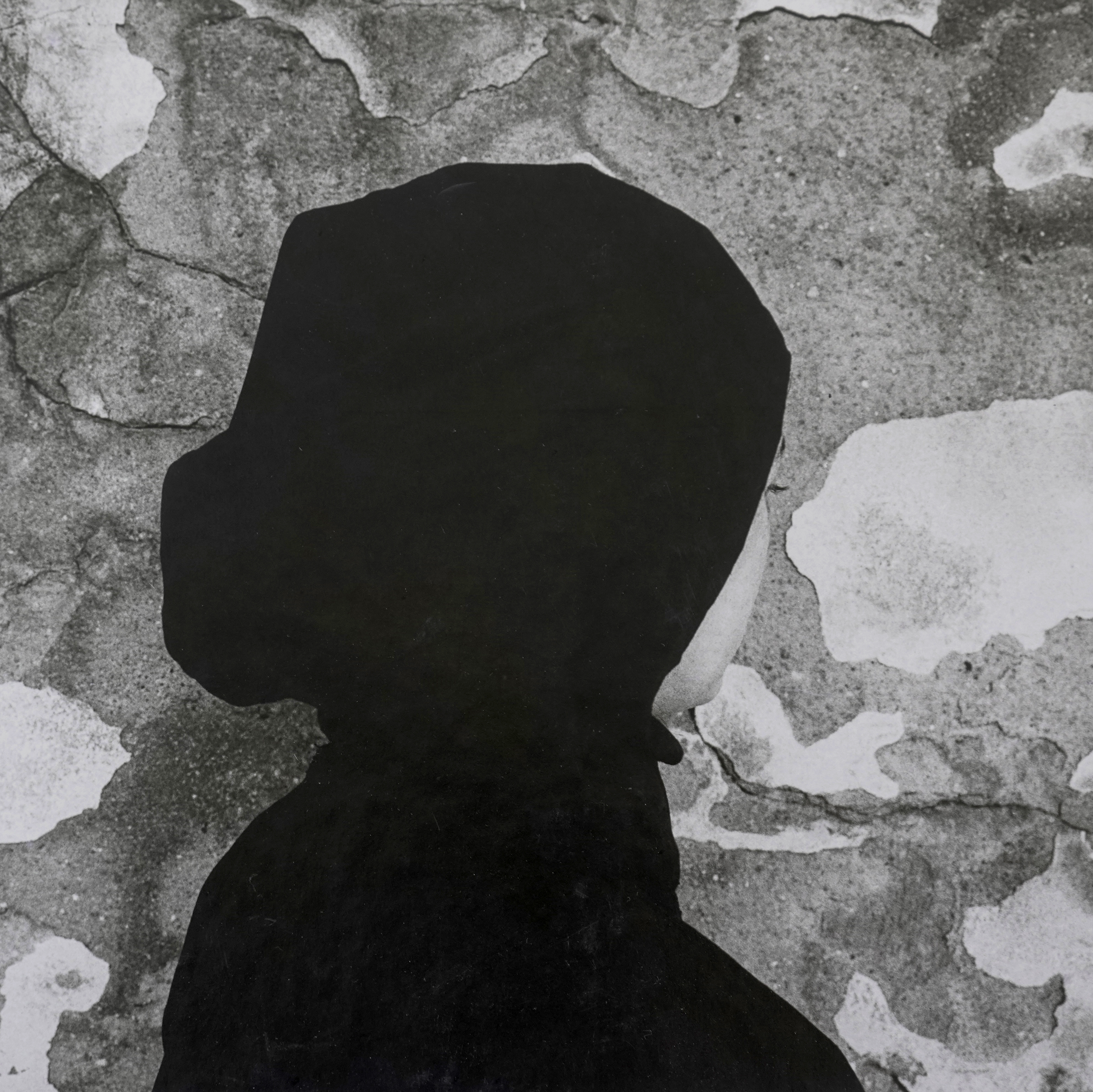
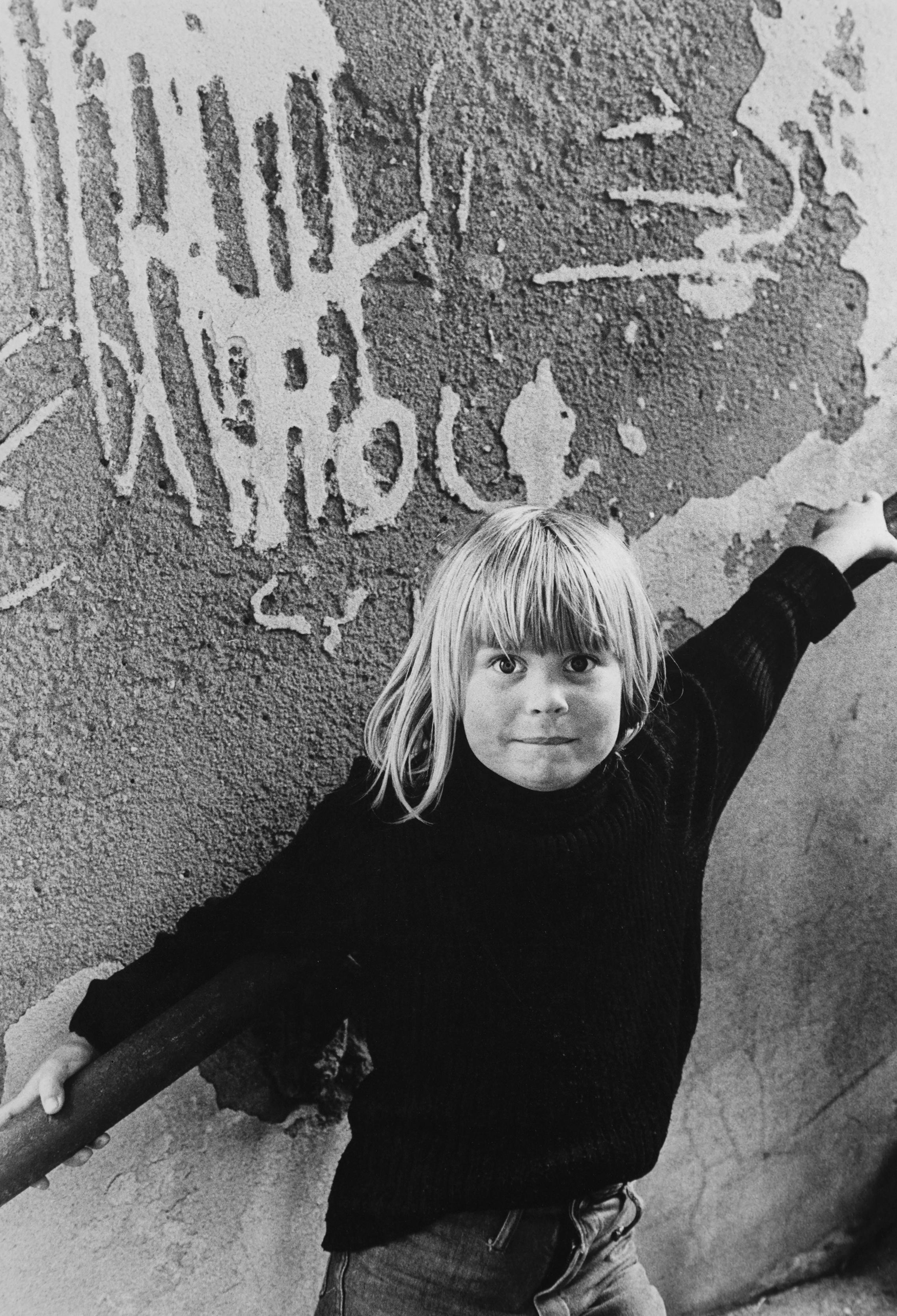
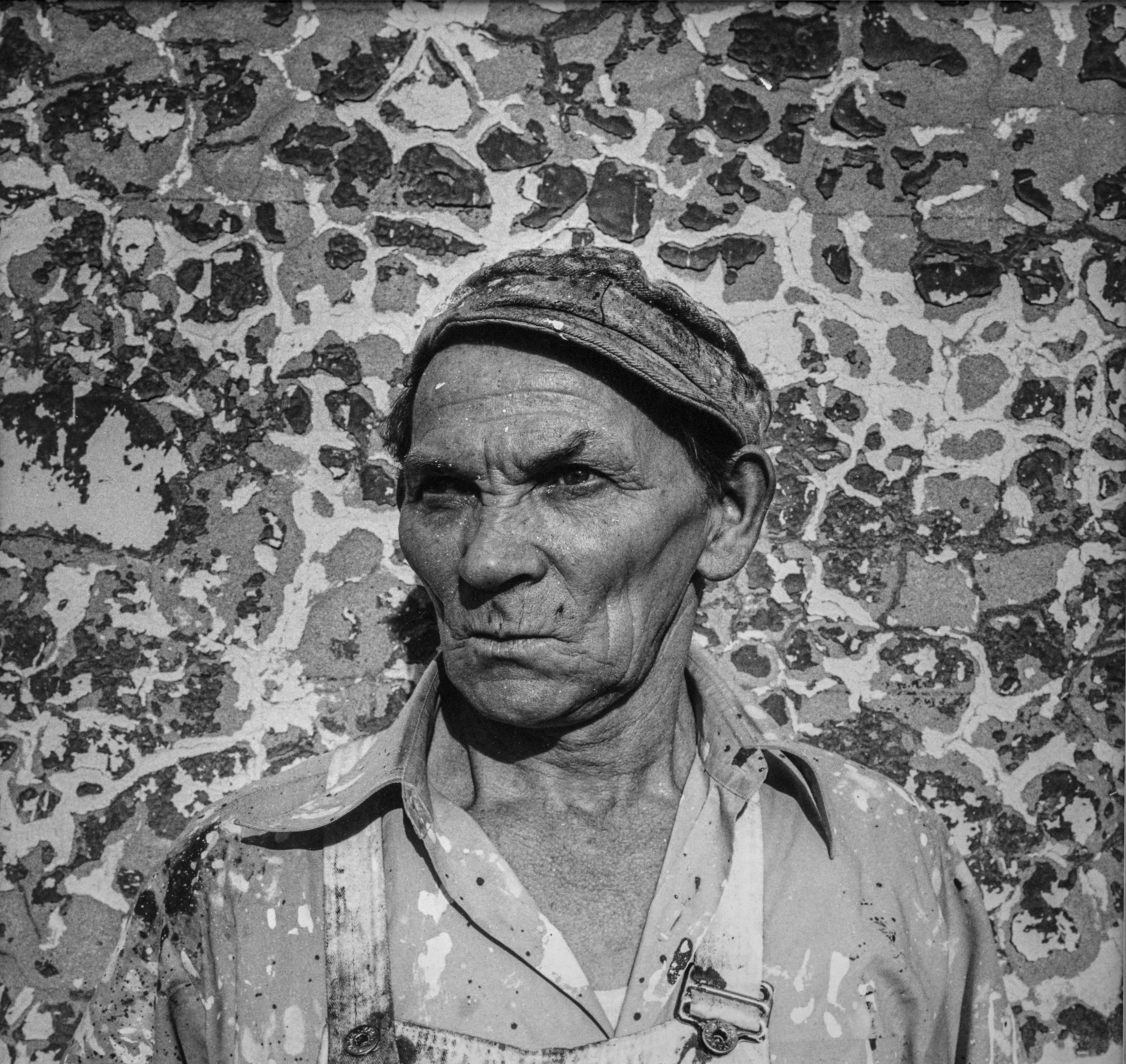
Prahran students were encouraged to produce thematic folios and Sandra’s response was a sophisticated consideration of that challenge. This series, also from 1975, is titled for the strongly textured walls seen behind what one would normally consider the main motif, setting the flatness of the picture plane against the three-dimensionality of the subject:
“This picture, taken on the St Kilda Lower Esplanade represents a transition from the ‘found’ to the ‘constructed’ image approach, purposely relating the sitter to the wall. I was fascinated by low key tonality in the diffuse sunlight and the challenge to exposure and film development to successfully record and print tones low on the greyscale. This image is from a figure in the landscape series – black figures and textured walls.”
Sandra Graham (1975) Walls 2
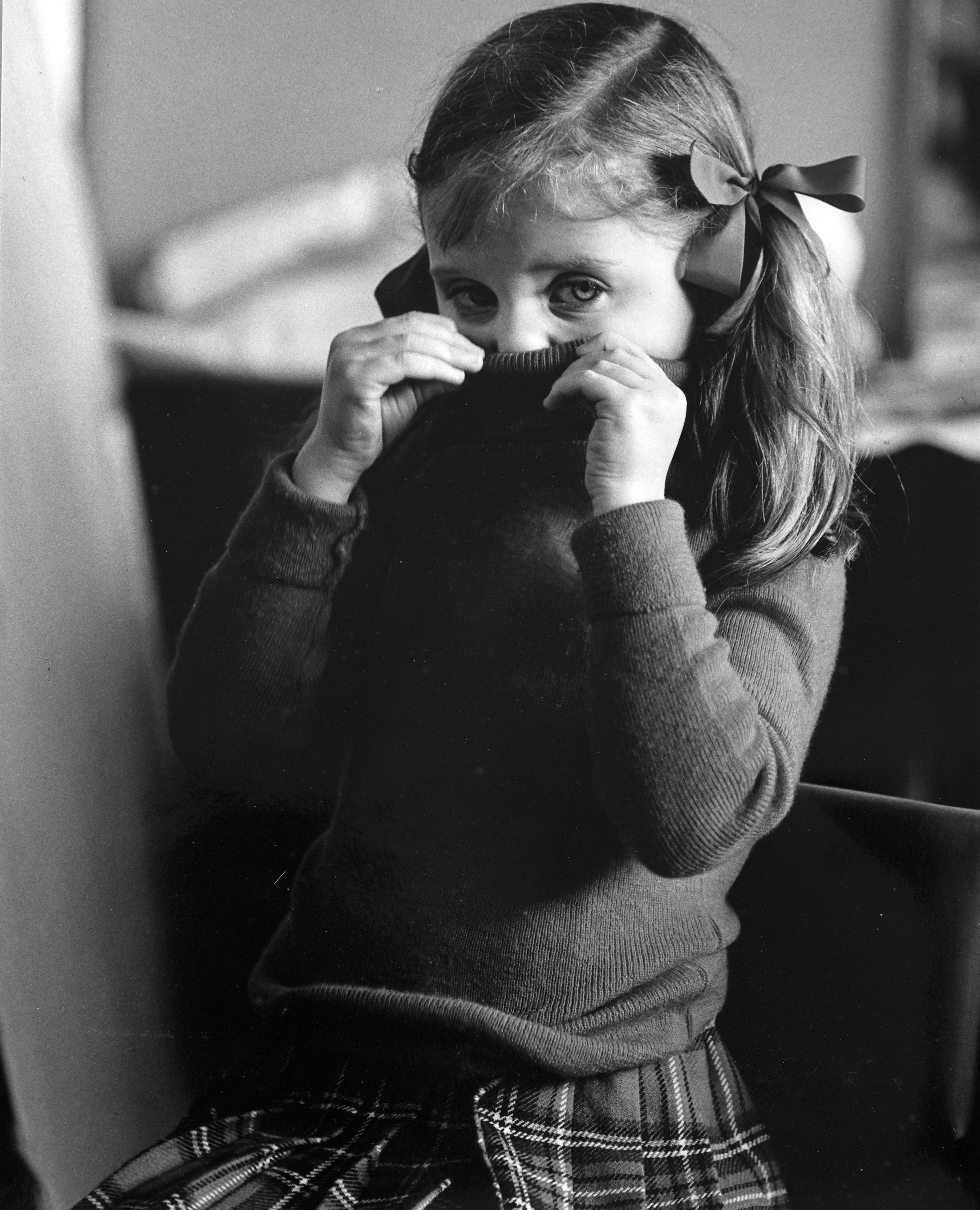
“The stairway from the main Esplanade in St Kilda down to the lower beach road was lit with soft daylight from top and both sides. The child was playing there while her parents set up a stall at the Sunday market above on the main road. My formalist preoccupation with the figure-ground relationship is evident here.
“The walls were maps, small universes of meaning. The outer world counterpointed by the inner self in the eyes of the child. The wall suggested the word “whole” to me as I watched it appear in the developer tray.”
Sandra Graham (1975) Walls 1
“I was driving, with my dog beside me, through Albert Park, Melbourne…and seeing this was like a lightning strike, this man, and this wall. So alive! Another map; this time to me the subject was embedded in the wall. His name was Joseph and he was about to paint that wall white… I spent about 15 minutes photographing him in the direct sunlight with no fill.”
Sandra Graham (1975) Walls 3
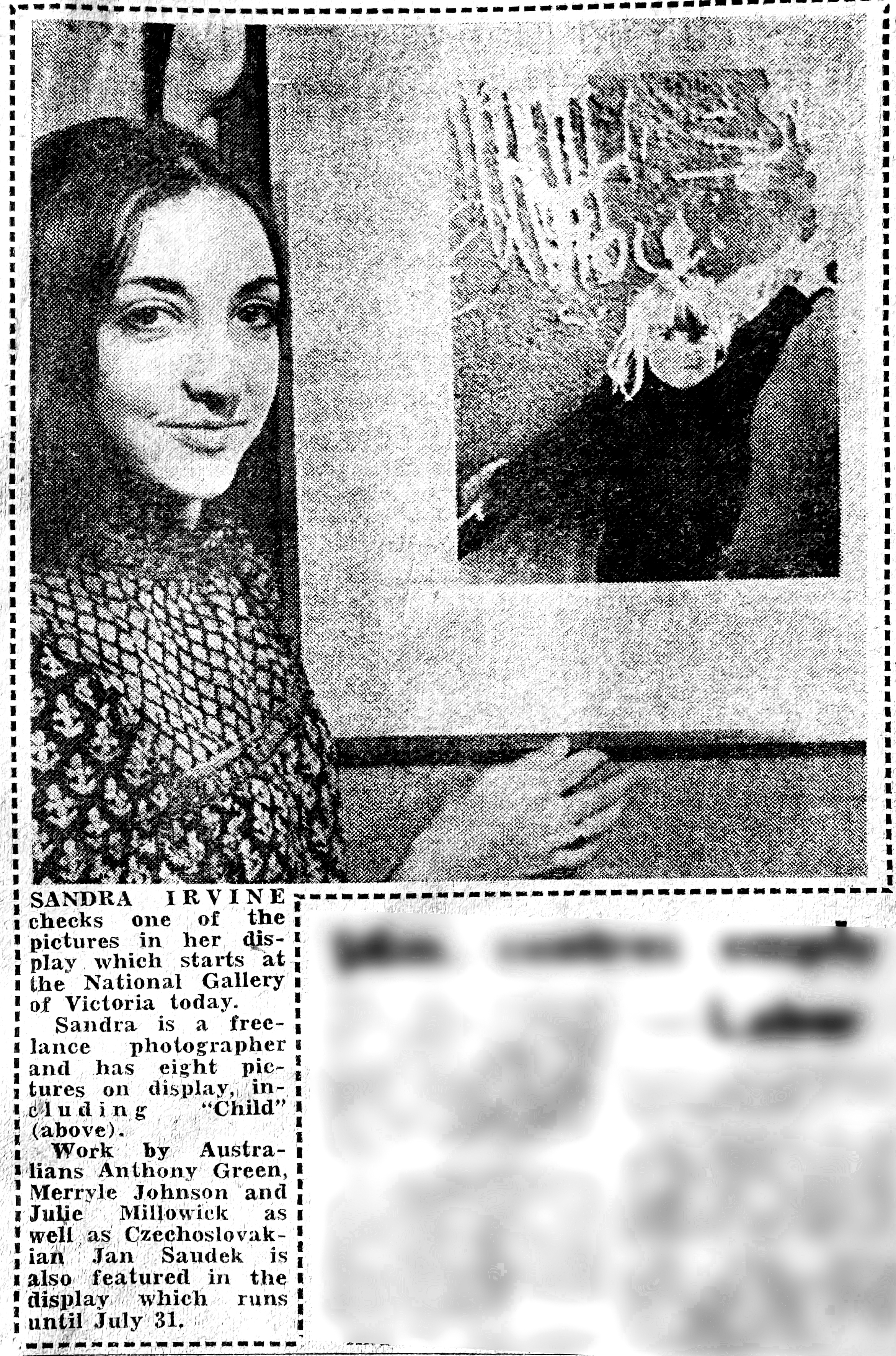
After her graduation Jennie Boddington at the National Gallery of Victoria showed her work alongside that of Czechoslovakian Jan Saudek over June and July 1977 in an exhibition of ‘four young Australians’; with Anthony Green, Merryle Johnson and Julie Millowick in the Photography Gallery on the third floor.
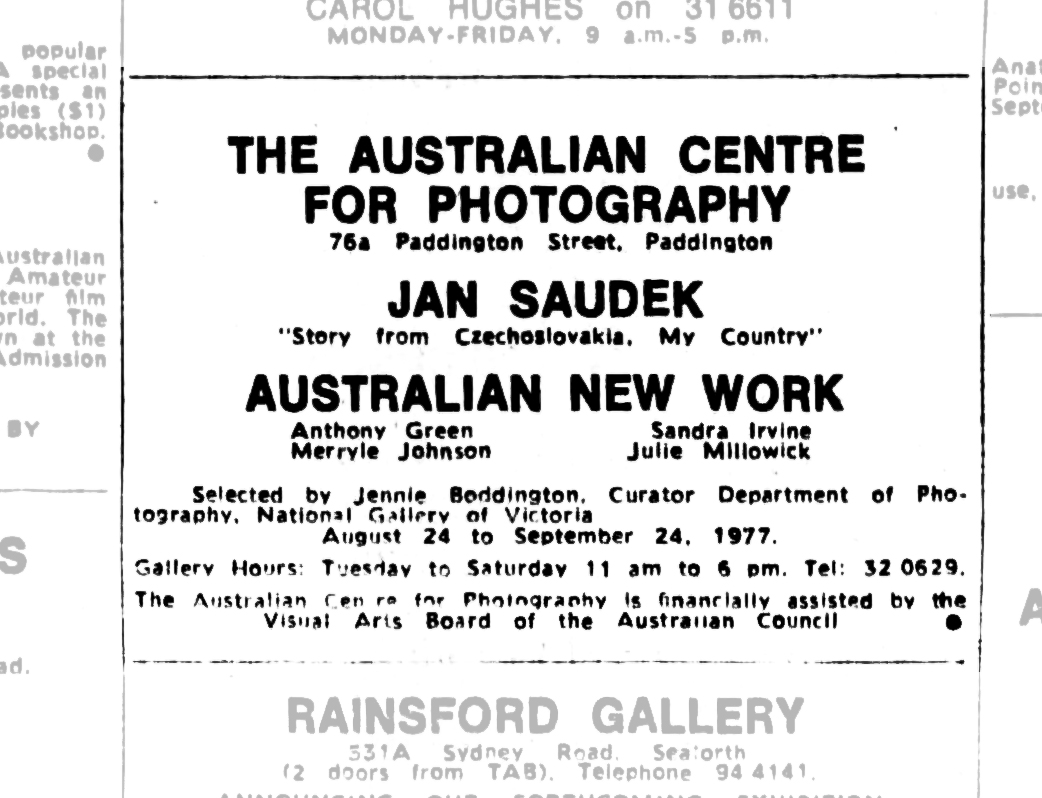
Both exhibitions then travelled in August to Sydney’s The Australian Centre for Photography which was then in its third year.
Advertisement, The Sydney Morning Herald 10 September 1977, p.39
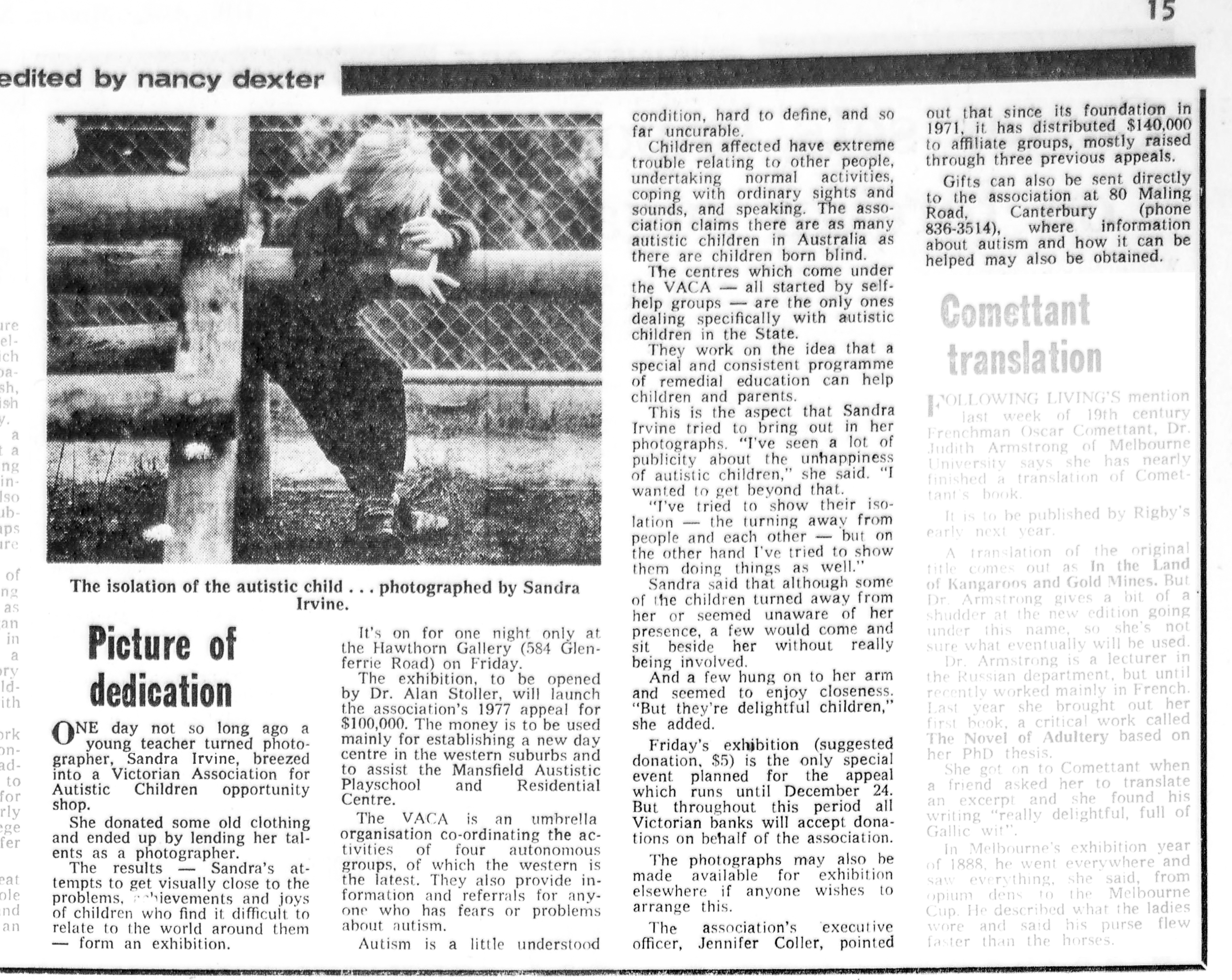
In November that year The Age carried this story:
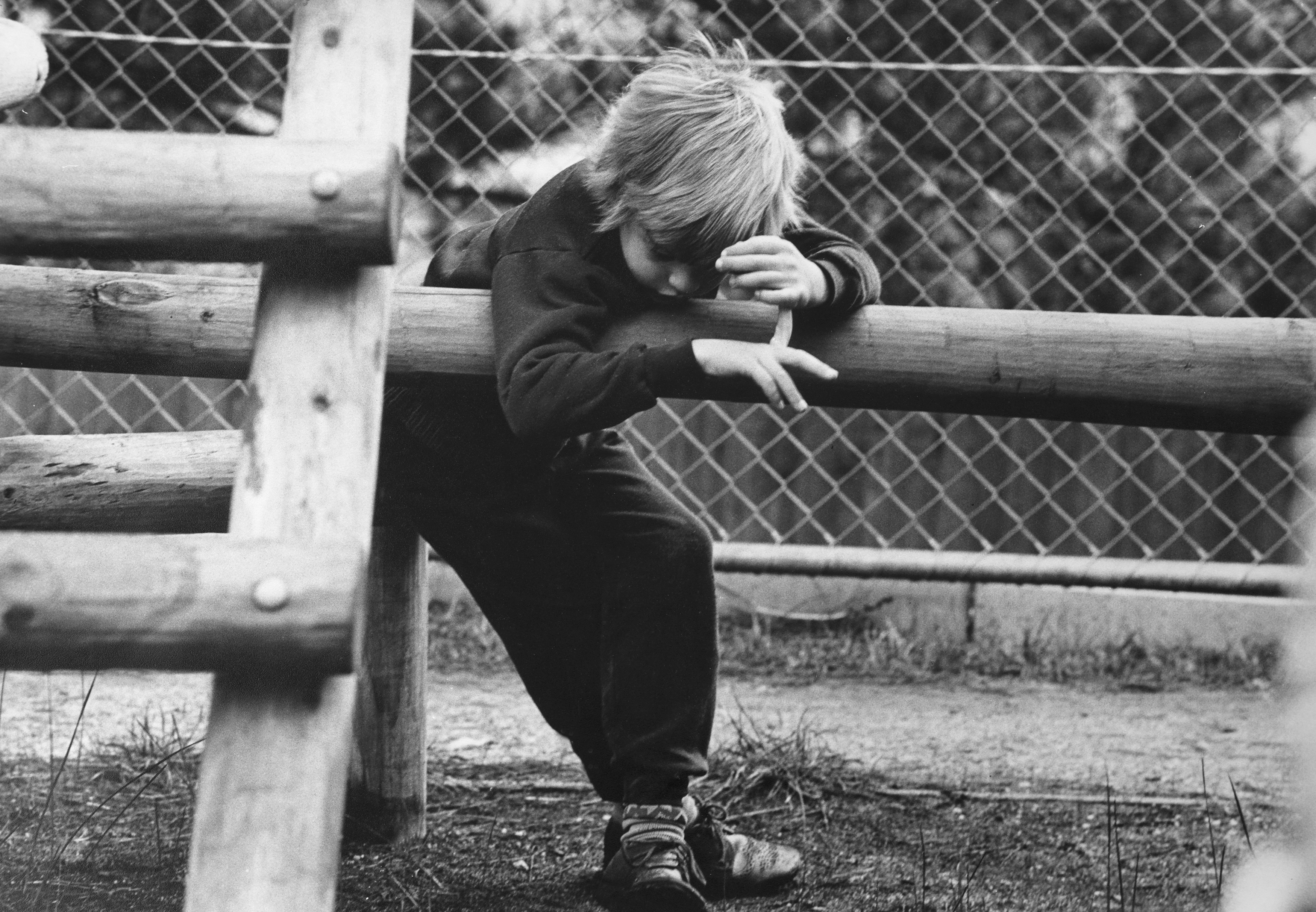
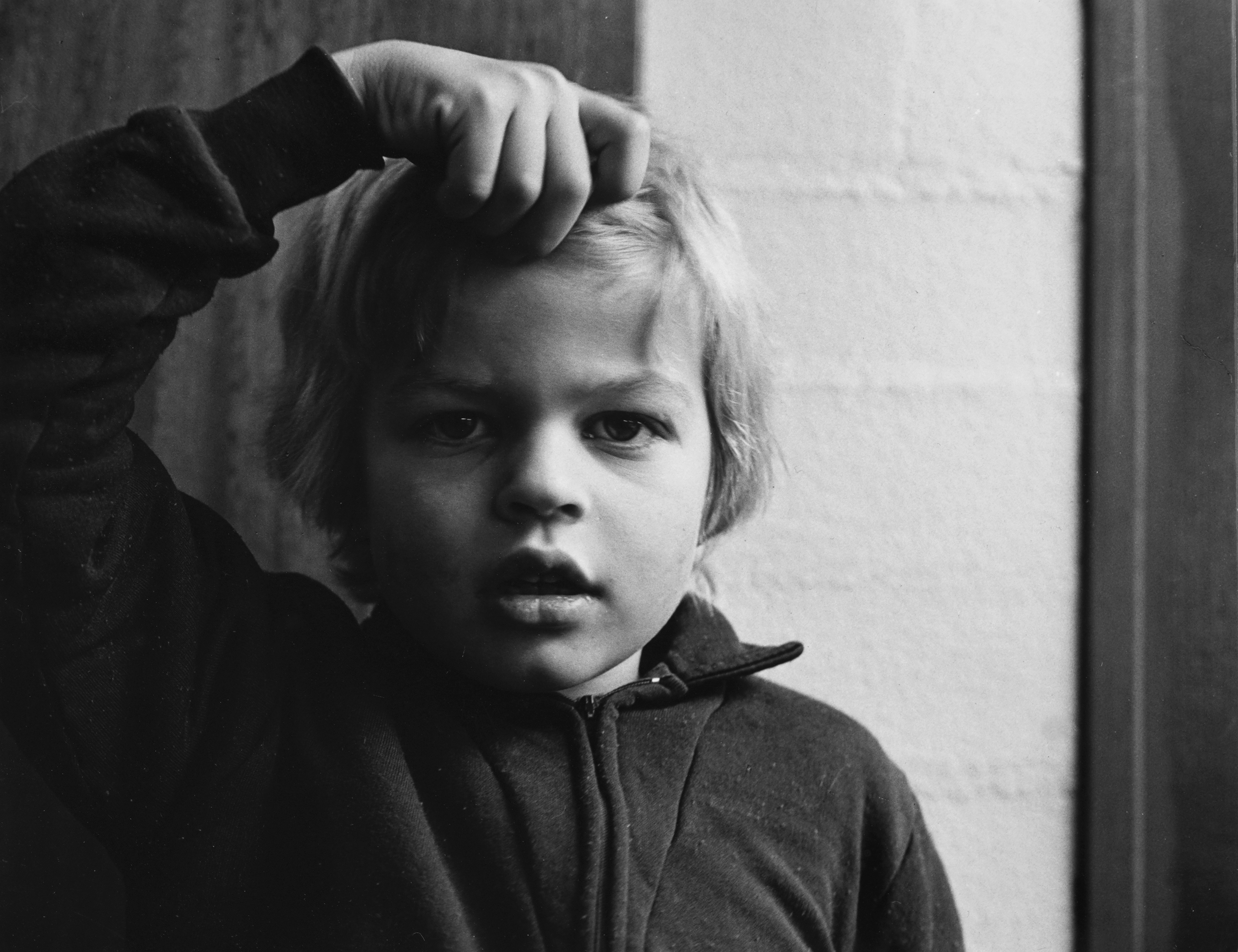
“One day not so long, ago a young teacher turned photographer Sandra Irvine, breezed into a Victorian Association for Autistic Children opportunity shop. She donated some old clothing and ended up by lending her talents as a photographer. The results —Sandra’s attempts to get visually close to the problems, ahievements and joys of children who find it difficult to relate to the world around them—form an exhibition.”
The Age, Monday 14 November 1977, p.15Sandra Graham (1976) Portrait of autism 1Sandra Graham (1976) Portrait of autism 3Sandra Graham (1976) Portrait of autism 2
The exhibition was opened by Dr. Alan Stoller to launch the association’s 1977 appeal for $100,000 to be used mainly for establishing a new day centre in the western suburbs and to assist the Mansfield Austistic Playschool and Residential Centre.
From December 1978 to December 1980 Sandra, like several other Prahran alumni including John Tweg, Steven Lojewski, Peter Leiss, and Moria Joseph, was employed at Melbourne’s Council of Adult Education to teach hobby and advanced level photography classes including ‘Photography 1’ (the basics of darkroom and camera techniques, developing. enlarging and all practical aspects and some studio work), Photography 2 which was in-depth for those who could already develop and print black and white film and which aimed to “develop an understanding of photography as a visual means of expression through practical involvement in the following finer black and white printing techniques, film/paper/chemical combinations, experimental printing methods, studio lighting, aspects of visual composition, retouching and presentation,” and also a ‘Printing refresher course.’
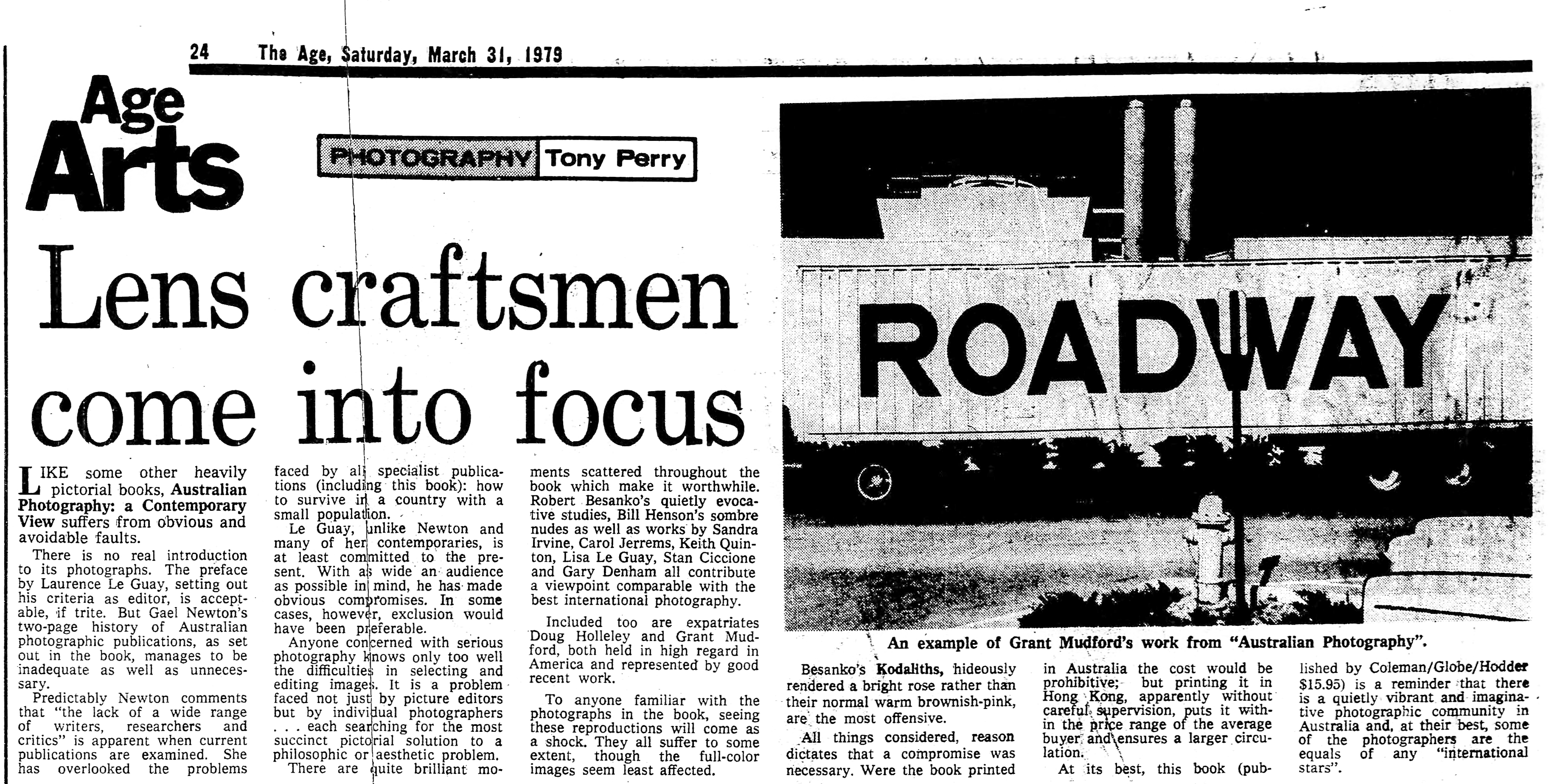
Laurence Le Guay in 1978 published a survey Australian Photography: a Contemporary View (Sydney J.H. Coleman Globe Pub.) with a double spread devoted to Sandra Graham’s student imagery. Tony Perry, reviewing it in The Age in March 1979 associates her work with that of Robert Besanko, Bill Henson, Carol Jerrems and others as being “comparable with the best international photography.”
Tony Perry, review of Australian Photography: A Contemporary View, in The Age, Saturday, 31 March 1979
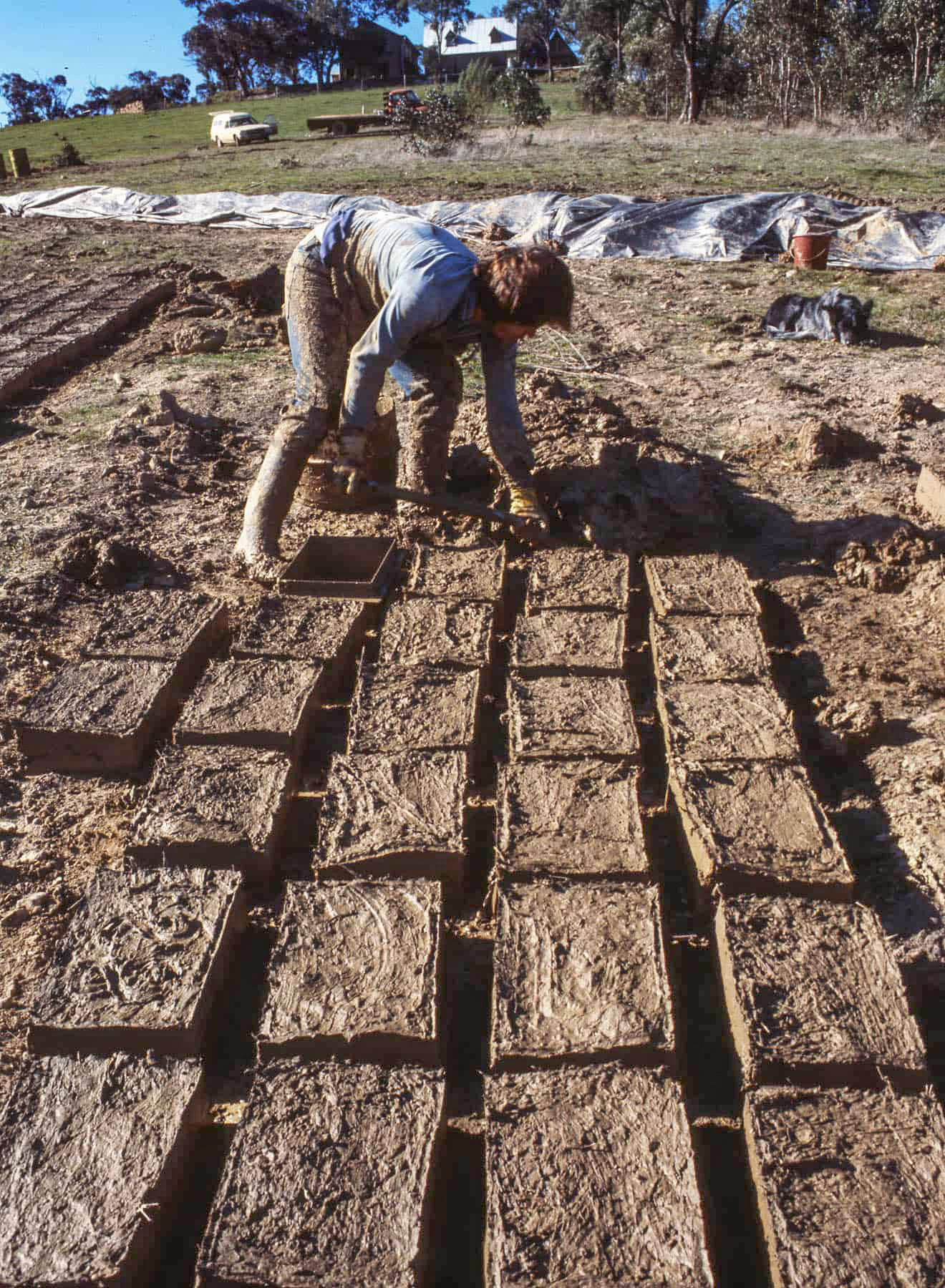
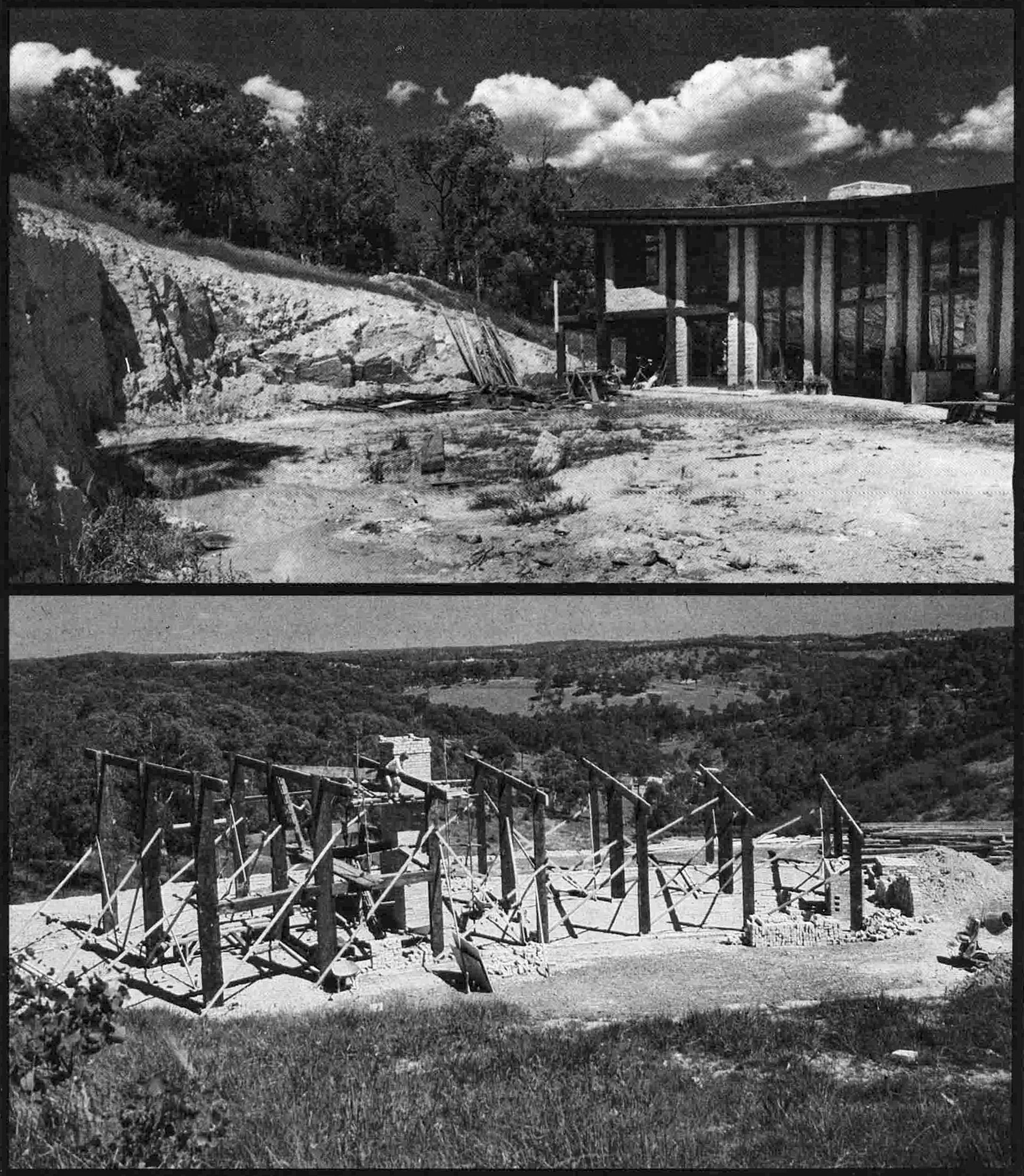
In the meantime Sandra was commissioned as photographer for Melbourne University and also conducted a freelance business in editorial photography through which in 1980 she provided illustrations for a book Alternative Housing: Building with the Head, the Heart and the Hand (Sutherland, N.S.W.: Albatross Books) by Alistair Knox (1912-1986). The Australian designer, builder and landscape architect was known for his use of recycled materials and as a pioneer of modern mudbrick building, having designed more than 1,000 houses throughout the Nillumbik region of Victoria.
Sandra Graham (1980) A member of Robert Bakes’ mud-brick circus at work. From Alistair Knox (1980) Alternative Housing: Building with the Head, the Heart and the Hand (Sutherland, N.S.W.: Albatross Books)
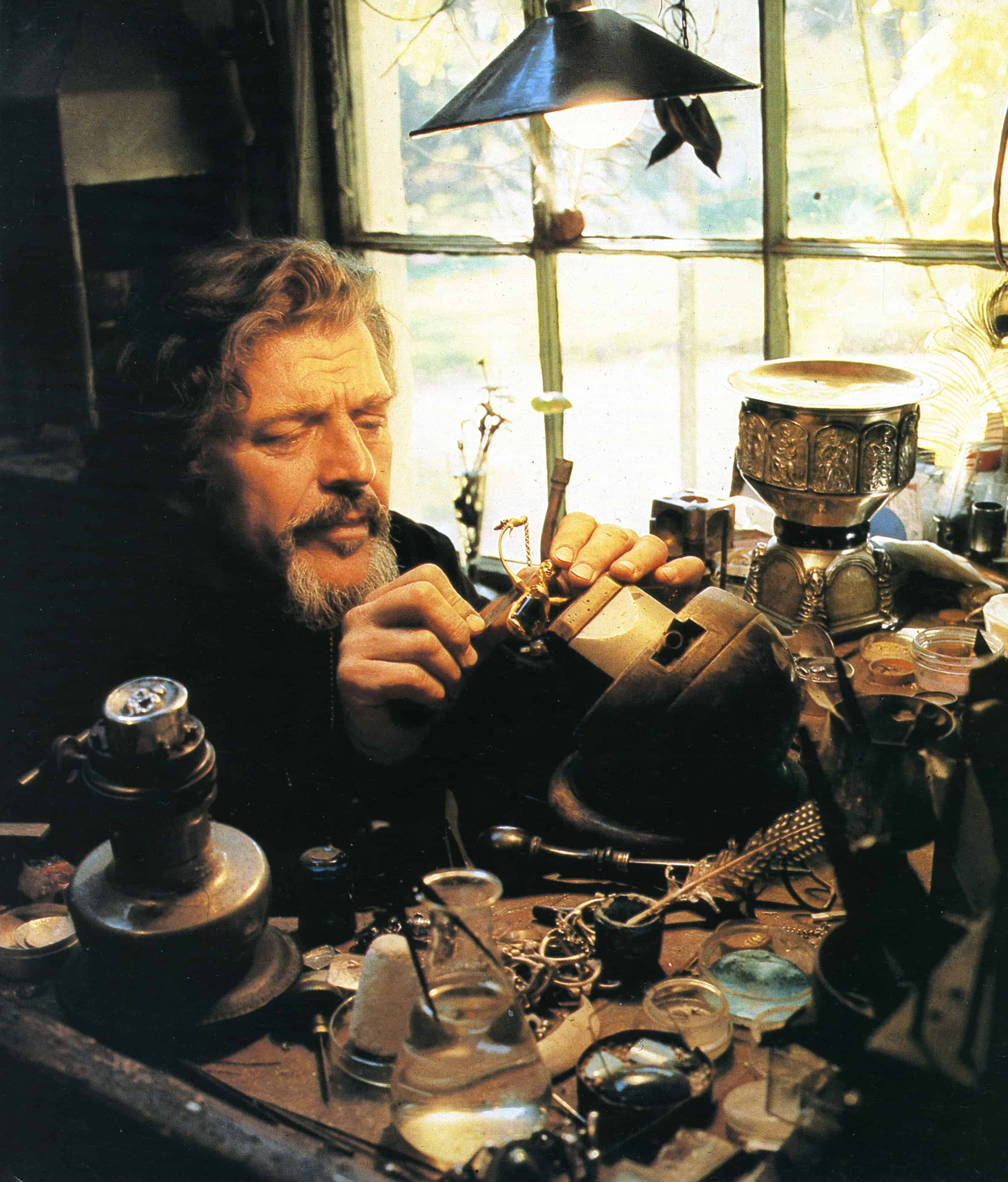
Graham’s pictures convey, through their raking sunlight on freshly poured mud bricks, the gloss of beeswaxed timber, and in images of warm wholemeal loaves and the mediaeval atmosphere of Montsalvat, the ‘down to earth’ movement prevalent then amongst a considerable cohort of the Victorian population.
Sandra Graham (1980) Matcham Skipper at work in his jewellery studio at Montsalvat. From Alistair Knox (1980) Alternative Housing: Building with the Head, the Heart and the Hand (Sutherland, N.S.W.: Albatross Books)Sandra Graham (c.1980) Above top The oval courtyard of the Pittard house before landscaping. Above bottom Jim Pittard’s adzed posts of King Billy pine forming the curved shape of his house and the oval courtyard. From Alistair Knox (1980) Alternative Housing: Building with the Head, the Heart and the Hand (Sutherland, N.S.W.: Albatross Books)
In 1980 Sandra was hired as a tutor at Photography Studies College at 61-67 City Road, Southbank (formerly South Melbourne), the privately-run rival to Prahran College which in 1978 had changed its name from the ‘Gallery School of Photographic Art’ adopted when it was founded by Roger Hayne in 1973. Lecturer John Cato taught there briefly before his appointment at Prahran College, alumni of which were also tutors at PSC at various times, including Philip Quirk, Ian Cherchi, Julie Millowick, Greg Neville, Lynette Zeeng, Christopher Köller, Carolyn Lewens and James McArdle.
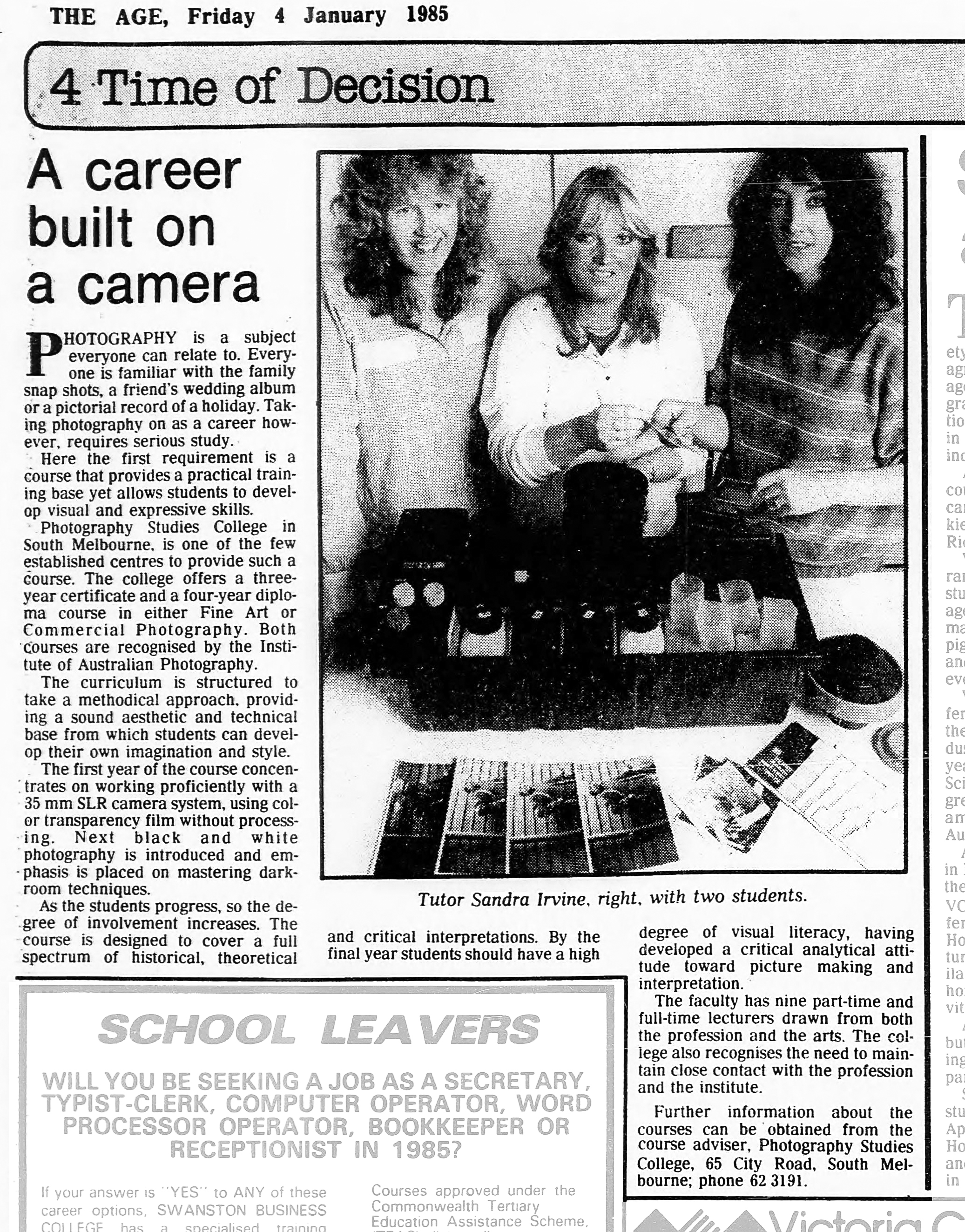
Sandra coordinated an innovative photojournalism program in which students worked “on location” in community organisations including the school for autistic children, building on her contacts there, the Police Training Academy, the Royal Children’s Hospital and the Gertrude street Artists’ Space among others that had granted entrée to PSC students and their cameras. In an 4 October 1984 article in The Age on her initiative, Sandra emphasised that it required an interactive process between photographer and subject in which collaboratively “making a picture” yielded more empathetic results than “taking a picture.”
She devised a “rapport scale” for her photography students in which, at the bottom end of the scale they and their subjects would experience “denial, unease and exploitation,” while at the other end is “easy and open access”. She urged her students to always aim to keep the session at the top end of that scale:
“If it’s photographs and not snapshots you’re after then patience is something you’ll have to learn. The shutter may open and close within a fracton of a second, but professional photographers invest many hours of thought and work before pressing any buttons. Many times I’ve spent hours with people without taking a single shot. It’s all part of working towards the upper end of the “rapport” scale. It you want a picture of someone “at work’ then you know the rapport scale is functioning when you take your camera out, start shooting and your subject hasn’t even noticed.”
Sandra advised that entering a genuine dialogue with one’s subject, beyond a vague curiosity, while photographing conveys a sincere interest in them and would lead to a good photograph. She recommended a camera like her own, with a waist level view finder, enabled keeping continuous eye contact with the subject. Warning against the amateur mistake of failing to consider the background when framing an image, she emphasised a consciousness of conveying context so that
“everything you see through the viewfinder is what you want. When you look through a camera you are in fact making an editing decision – what shall I include and what shall I exclude? The person who makes that decision consciously will be a better photographer.”
In 1982 Sandra conducted a workshop at Arles photography festival. Drawing on her experience and portfolio she contribute to If You Knew Nicky, one a series of books for children on medical issues written by Pearl M. Wilson, a journalist, in 1983. It is about Anna who loves typical childhood activities, but her life is different because her brother Nicky has autism. This brings challenges like long trips to his special school and frequent visits to specialists. Despite sleepless nights and tantrums, Anna and her parents manage with patience and love, showing that understanding can help overcome difficult situations.
John Quicke in his 1985 Disability in Modern Children’s Fiction (London, Cambridge, MA: Croom Helm ; Brookline Books. p.148-9) acknowledges how pictures make such books accessible to younger children as well as adults, but his dismissive discussion of If You Knew Nicky betrays his own prejudices about autism and in the process, also how difficult a task it is to visually present the condition :
“there is a danger of the books falling between several stools and appealing to no one. P. Wilson’s and S. Irvine’s If You Knew Nicky is […] a short book with glossy photographs about an autistic boy, Nicky. The foreword is clearly intended for the adult reader, and is a simple explanation by a psychologist with a string of letters after her name about this ‘rare and mysterious childhood disorder’. There is an above-average amount of text accompanying the pictures which seems to make it more suitable for a junior age child, but one wonders if even a child of this age would understand what was really the matter with Nicky? His behaviour is supposed to be mysterious (even the experts themselves, as the foreword acknowledges, are baffled by this condition), and yet superficially no one piece of behaviour in itself is particularly strange from a child’s viewpoint. Many children play with the same thing over and over again, sometimes, if not all the time, and sometimes ‘normal’ children are awkward and do not like to be cuddled.”
The Age, Friday 4 January 1985
In 1984 Sandra organised for July 1985 a photography tour of China with tuition for PSC students. Such responsibilities meant that her tenure at PSC continued in a senior role, and into the 1990s when the college started to offer a Bachelor Arts Photography association with RMIT, the institution where she was next employed, as Program Manager for the BA Photography, until 2010. She was acknowledged by Mark Galer as a contributor of her own students’ imagery in his texts Location Photography and Photographic lighting.
By then, and like other alumni who went into such roles, giving her full attention to teaching photography and the demands of administration in the tertiary sector had become Sandra’s main focus against which making her own pictures had necessarily become secondary. She was recognised in 2004 with the RMIT Student Centred Teaching Award and RMIT University Teaching Award 2004, and in 2005 with a Certificate of Achievement in the Australian Awards for University teaching.
In interview to Bill Henson remarks provocatively that “art education is an oxymoron”.
When asked for her own perspective on educating artists Sandra quotes American professor of Art and Education, Elliot Eisner (1933–2014) who wrote:
“If the visual arts teach one lesson, it is that seeing is central to making. Seeing, rather than mere looking, requires an enlightened eye: this is as true and as important in understanding and improving education as in a painting.”
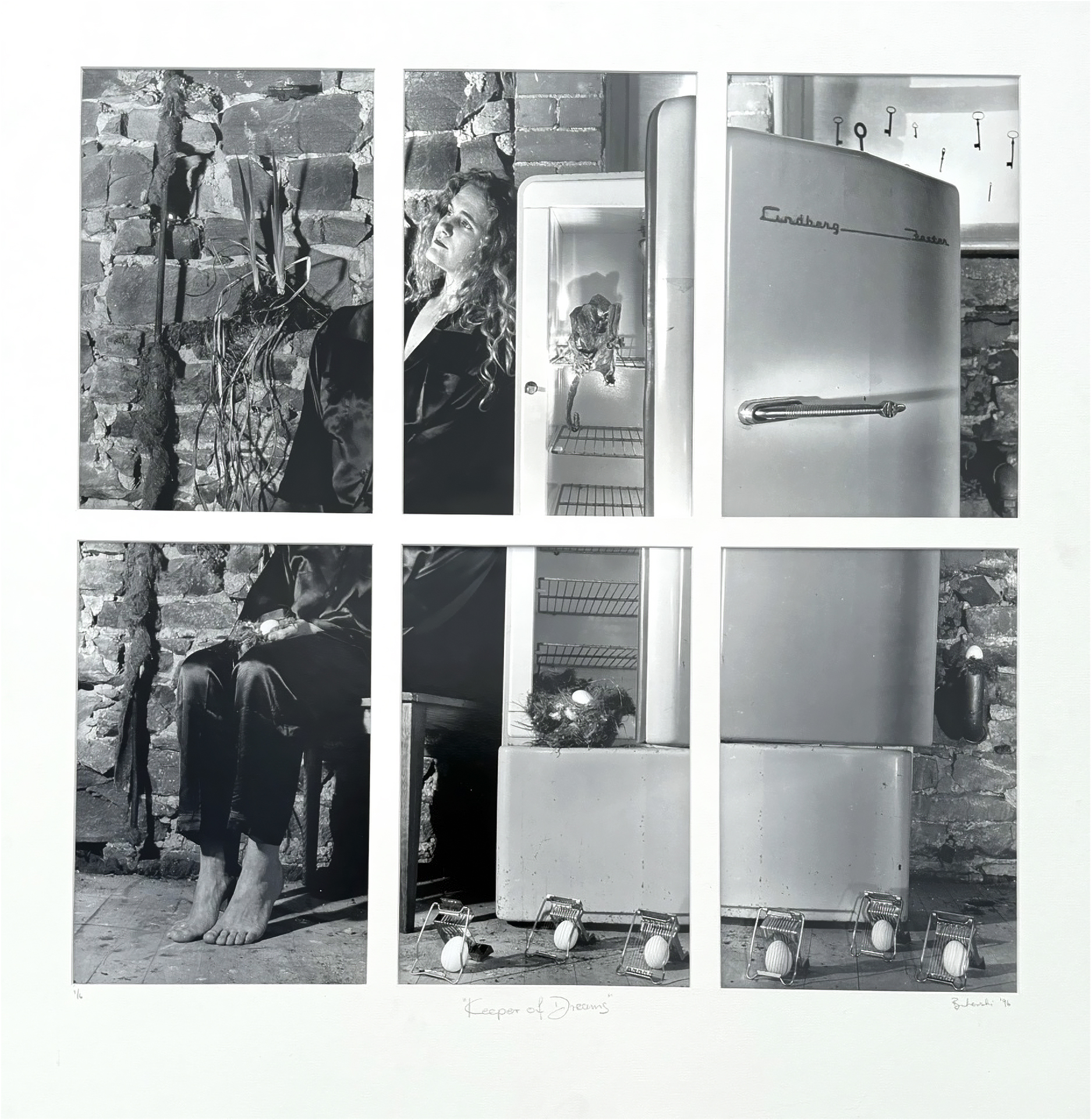
Considering her own approach she includes an example of work by one of her RMIT students that she feels demonstrates how:
“An ‘enlightened eye’ is crucial to successful photography, but developing it is a process. In a 1-3 year educational program, a student’s perception of an image is the genesis, grown from their love for photography, which I refer to as ‘rapture’. Presenting problems to be solved in photography education fosters ideas and appreciation. While practice is essential, it must be directed by meaning-making to achieve articulate and persuasive outcomes. One instance is this first-year student from my class at RMIT who rose to a visual challenge and negotiated technical complexity. This strong result result demonstrates how a meaningful, well-planned educational pathway leads to aesthetic sophistication. Quality art education is not an oxymoron.”
Unnamed (1996) Keeper of Dreams, montage of six prints in cardboard matt.
 Both exhibitions then travelled in August to Sydney’s The Australian Centre for Photography which was then in its third year.
 Prahran Photography
9 thoughts on “The Alumni: Sandra Graham”