
Lisa Walker (b.1967) emerged as an artist during a pivot point in Australian photography after studying at Prahran College and graduating in 1987 with a Bachelor of Fine Arts in Photography. Prahran, then renowned as the crucible of Australian photographic art, fostered a climate of experimentation. Students were encouraged to push the boundaries of the medium—drawing as much from cinema, painting, and literature as from technical craft. Reflecting on her education, Walker recalls memories that “are rich, inspiring and full of creative inquiry and free expression” and remarked to fellow alumnus Chris Beck in his 1996 Age newspaper interview with her: “I was constantly visually stimulated and fed lots of images and art.”
Early exhibitions intoned Walker’s distinctive voice; an eloquent vocabulary of atmospheres for emotional affect. In 1986 she showed at the recently created Linden Gallery’s Women’s Group Exhibition, and in the Prahran Graduate Show at Lighthouse Gallery. A decade later, after exhibiting almost annually in group shows, with a seven–year hiatus devoted to work in media and television between 1987–94, she had her first significant solos of a series of untitled portraits at Melbourne’s Continental Café and Sydney’s L’Otel Café (1996).

 These black-and-white portraits were made on location in the last light of day. “The locations—the ocean, cityscapes, and landscapes—reflected the characters’ moods and provided them with a stage-like platform, transporting them from the mundane into the sublime,” wrote critic Chris Beck.
“It’s strength in people. I photograph them in a way that makes them look exceptional. They could be famous. We all have got that in us”
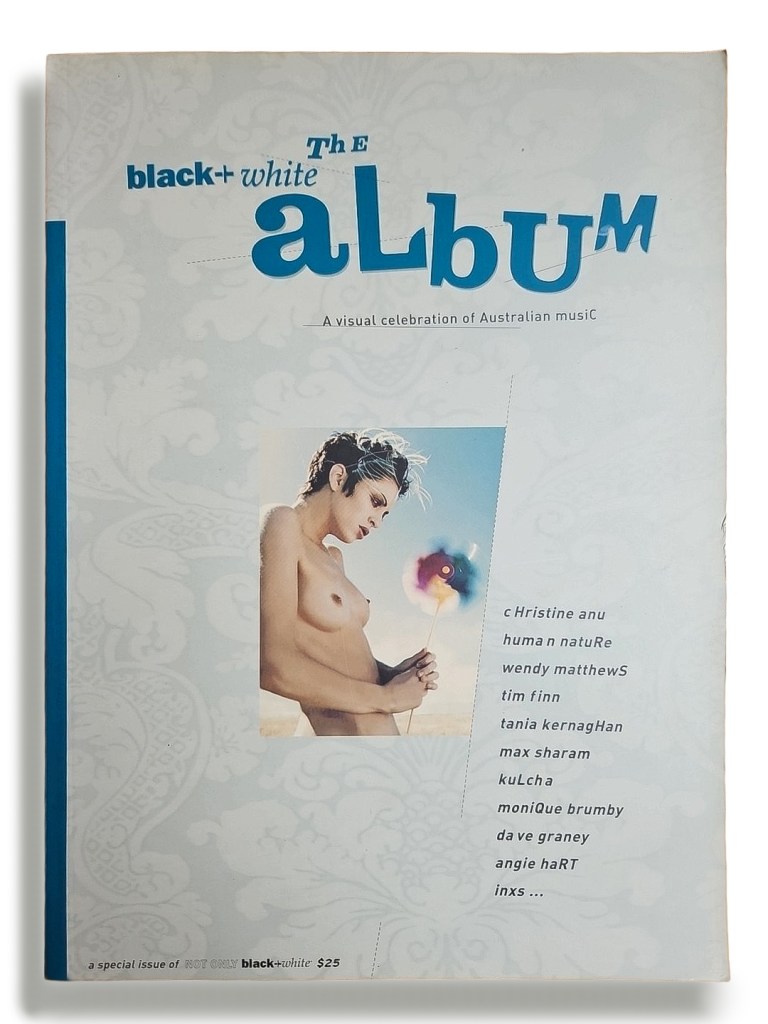
Such vaunting of her subjects’ presence, and their actual notability, drew attention also to her photography. In addition, through her work in the late eighties directing the fashion segments for the ABC youth program The Factory, hosted by Andrew Daddo and Alex Papps on ABC TV on Saturday mornings, work on the wardrobe for the national broadcaster’s youth music show Countdown Revolution (which ran mid-July 1989 to December 1990), shooting fashion photos for the Herald-Sun and portraits for Sin magazine in the mid-90s, it naturally followed that her photography of musicians should appear in Studio Magazines’ 1997 survey of the scene, The black + white album: a visual celebration of Australian music.
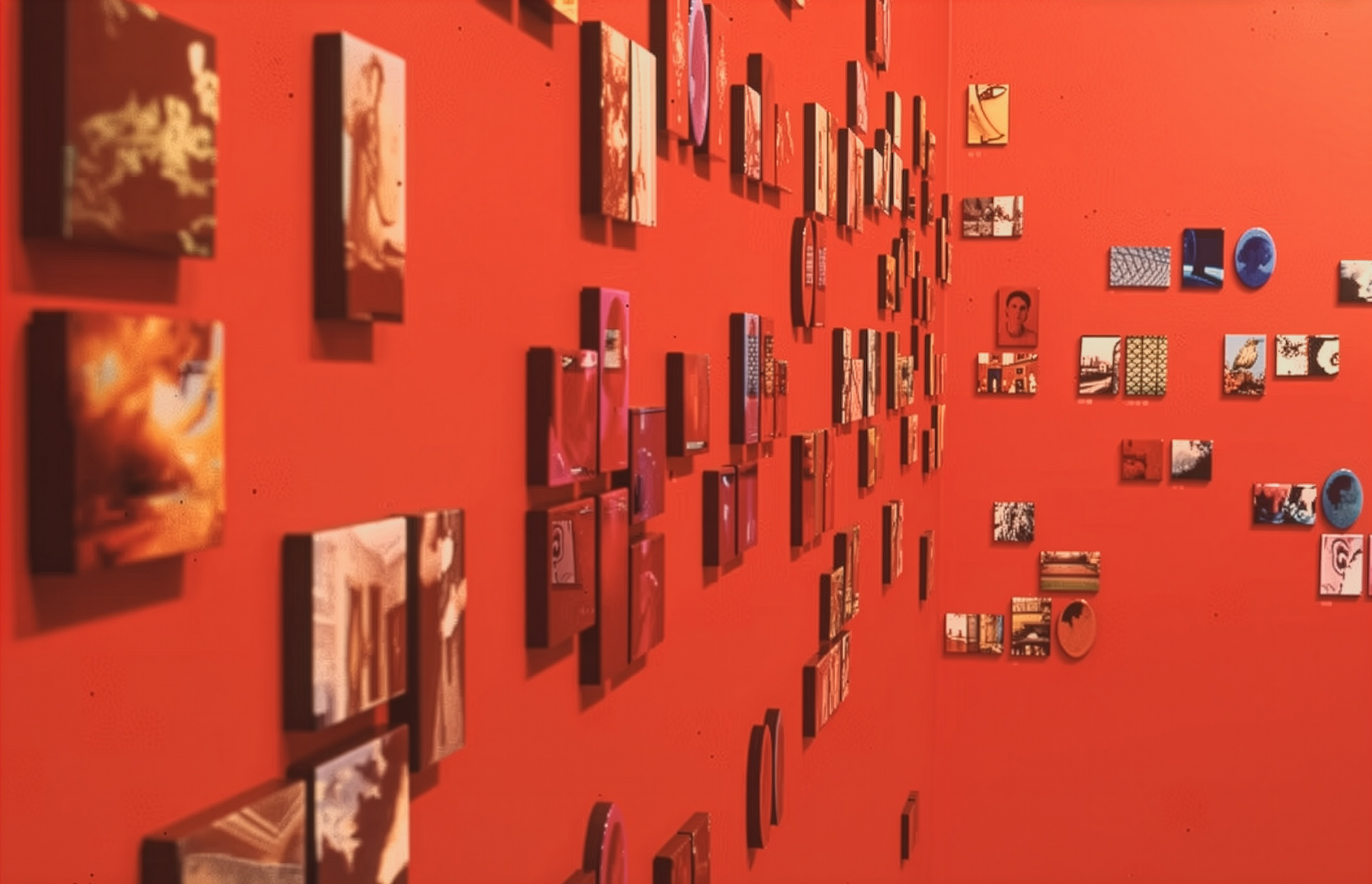
Walker’s exhibition Salon (1999) named for the densely-clustered, hierarchical displays of the 19th century academies, was immersive both in volume and colour “an extraordinary treasure trove of imagery… two hundred tiny landscapes, portraits and still–lifes hung on walls painted a deep and luxurious red. The result is daunting, rich, and intensely work-driven,” as art writer Ashley Crawford described it.

In 2000 Walker was commissioned to produce a permanent photographic installation in “Human Mind and Body” spanning life until death, for the new Scienceworks Museum; large–scale portraits depicting youth and age and the changes in the human body. In mid-March her abstracted renditions of fashion accoutrements startled pedestrians in the windows of Scanlan & Theodore as part of Melbourne Fashion Week.
Walker’s Pink Trees was at Ben Grady’s new gallery in Fyshwick, ACT. of whom Sasha Grishin (Art+Australia, vol.38, #2, 2001 p.323) notes that although born in Canberra, Grady, having lived in Melbourne for considerable periods, had a strong bias towards emerging Melbourne artists and planned a program of exhibitions that focus mainly on contemporary Australian art. Explaining his policy for the gallery, Grady noted that ‘there is a global style in contemporary art at the moment’ and intended to retain a number of his former artists, Vera Möller, Glen Dunn, Philip Hunter, Andrew Browne, Marie Hagerty, Janenne Eaton, Alex Asch, Peter Walsh, Peter Vandermark, Peter Graham, Andrew Powell, Craig Easton, Tommy Carroll and Katie Cox, to explore new talent and to feature more Indigenous artists and emerging international artists, and was of the opinion that the Canberra art market was too limited to support a gallery with only a small stable of artists.
Pink Trees was another ‘visual feast,’ this time for Myra McIntyre of the Canberra Times, (3 July 2000, p.12):

“Lisa Walker has a single outback landscape from the Pink Trees series as a central focus to her exhibition now at the Ben Grady Gallery. It is, however, the 181 small colour photographs accompanying the large colour-filtered image that allude to the desire of the artist to explore the many fascinations of the landscape of human personality and experience.
“Walker … presents a broad range of subjects in the small, sharp images that read as glimpses of personal visual landscapes. Each print is complete in its own right, but each lends itself to the possibility of a greater whole, a vignette or narrative that can be constructed and deconstructed at the whim of the viewer.
“Walker does not dictate meaning but allows the viewer to draw on the multiplicity of meanings effected by the combinations of a myriad textures, colours and shadows, fabrics, designs, architectural elements, landscape features, climatic effects, interior and exterior formats, flora and fauna, portraits and facial features. She incorporates time through the implementation of history with period furniture and portraiture and the manifestations of contemporary culture such as the four ‘disco light’ images. Mood is manipulated with the use of coloured filters—cyan, magenta, cerise—introducing an even greater intensity than normally afforded by C-type colour prints.
“Almost as a foil to the unusually restrained size of the works, they are block–mounted, the print sealed with a polyurethane glaze adding further to their mass, to present in the tradition of valued artworks, and strengthening the sense of image as object. Each one then reflects the precious nature of the fleeting moment and its impact, the learned appreciation and cultivated taste while sanctioning the promise of value in the collective experience. Walker draws on the adage that the value of the collective unity is greater than that of its constituent parts to successfully offer a visual feast of ingredients from which to create a personal landscape.”
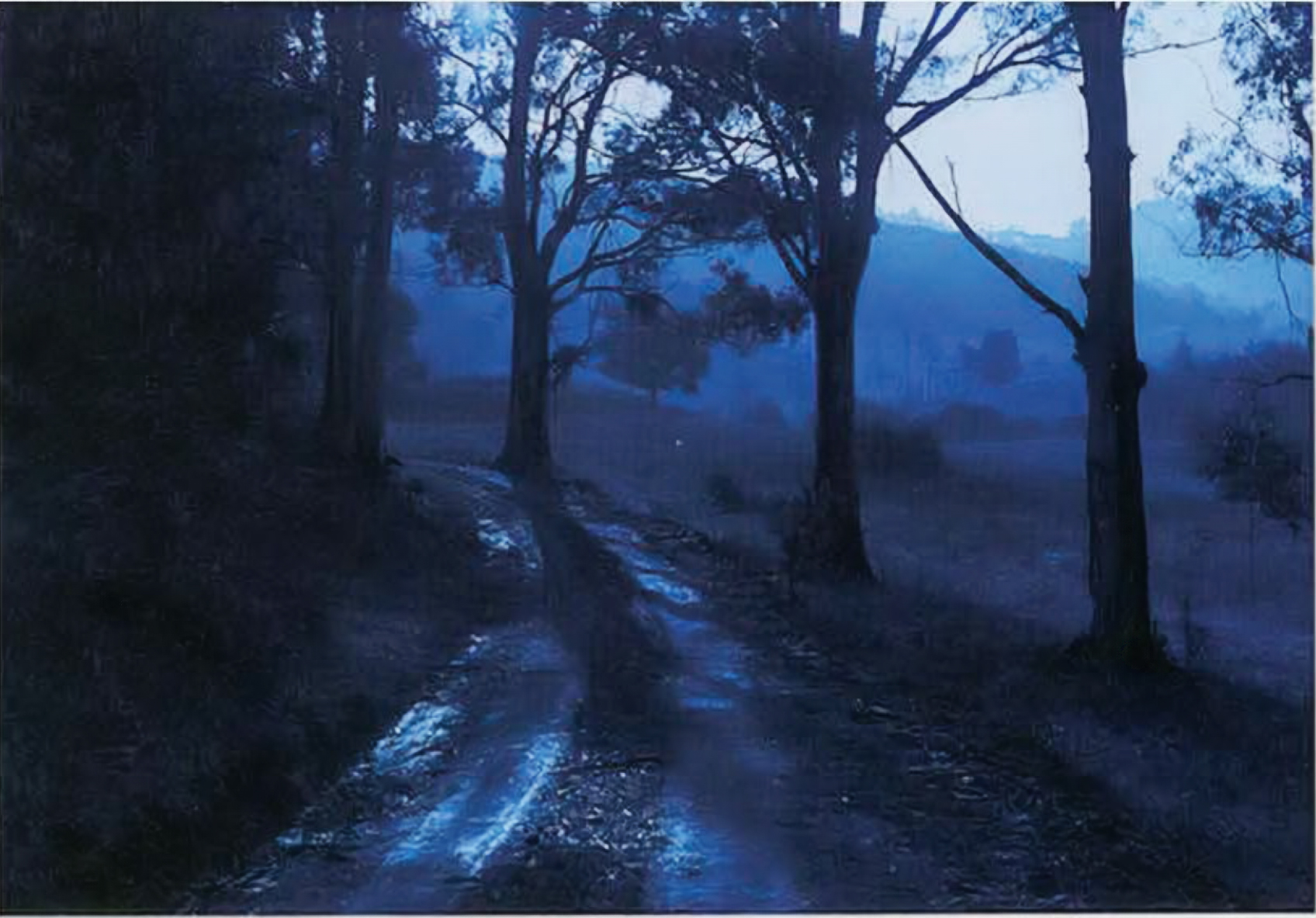 In 2001, for Colour Blind at Patrizia Autore Gallery in St Kilda, Walker again colour-saturated her imagery. The Australian landscape was displaced as an unsettling “European” theatre “in the tradition of French film noir” as Ashley Crawford expressed it in his Australian Art Collector review, noting how the works’ “unique colouration techniques and quirky, idiosyncratic framing” created “mystery and hidden threat, a sense of voyeurism, the feeling that the viewer has just missed playing witness in some bizarre event, or that such an event is just about to occur.”

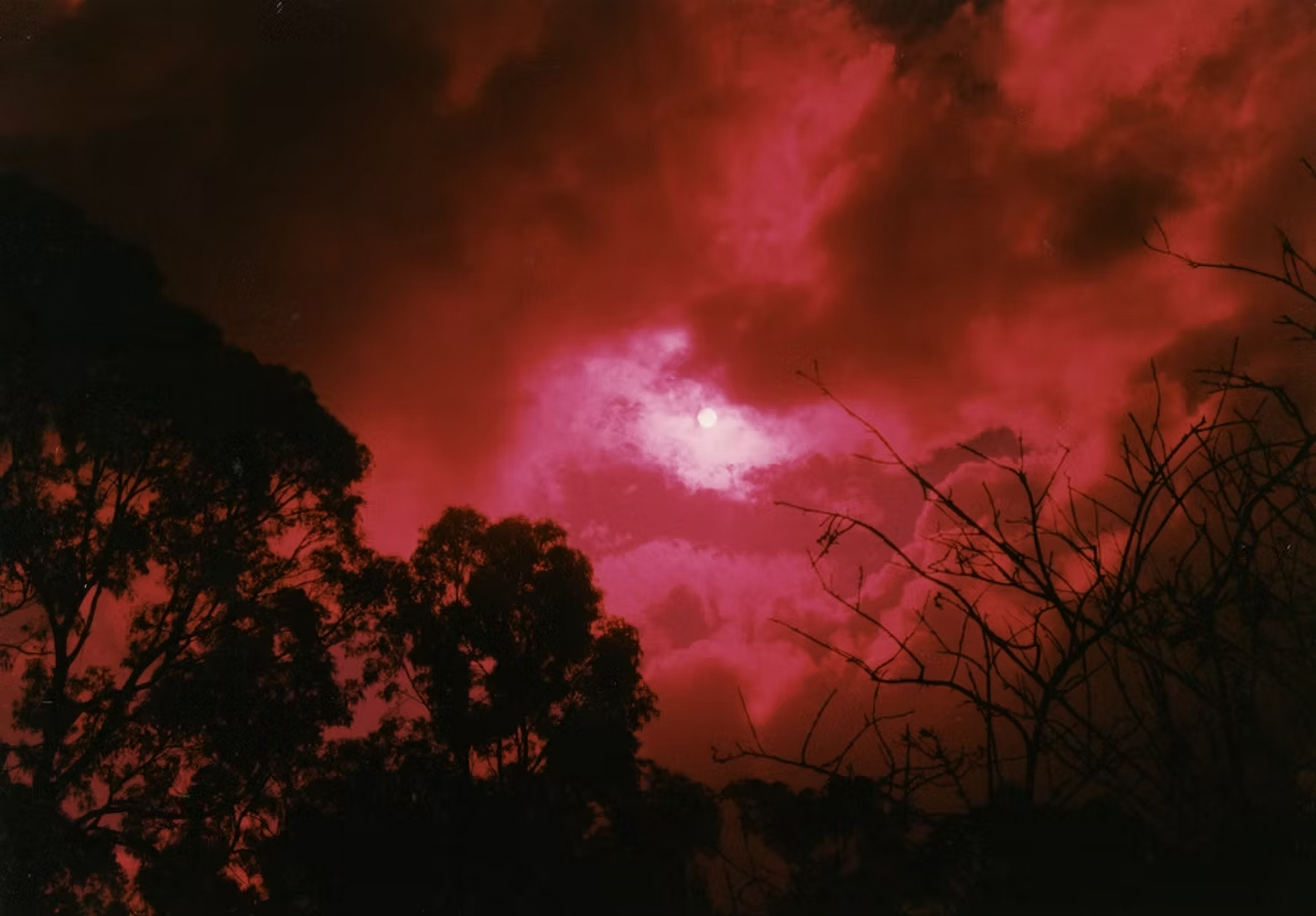
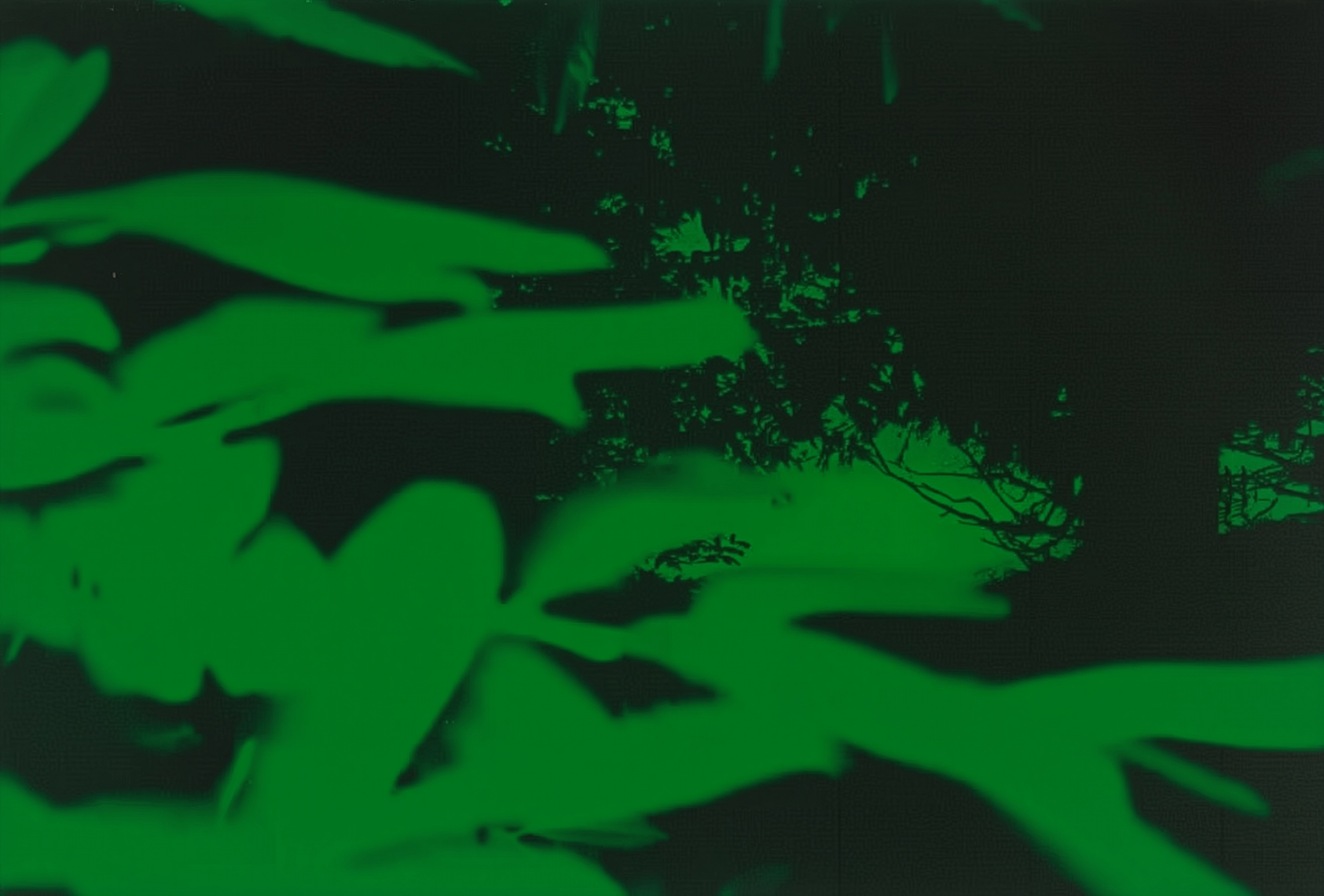
Her 2004 solo Foreboding, held at both Dickerson Galleries in Sydney (est. 1992) and Melbourne, expanded these themes, cementing her reputation as a photographer who could conjure psychological intensity through atmosphere alone. Reviewer Holly Evans (Sunday Age, 14 April 2004, p.2) noted her use of “coloured filters to enhance the drama of the Australian landscape”


With growing awareness of the attractive qualities of the ‘giclée’ print, Dickerson Galleries at 2a Waltham St, Richmond (established later, in 1999) announced that it was opening its ‘Paper Room’ in its upstairs atrium, with space also allocated to six emerging photographers including Lisa Walker and Mal McVeigh, who were printing on art papers with archival watercolour.
The following year Walker participated in a group show, also at Dickerson in its Naked Truth, for which established and emerging photographers Jane Burton, Natti Miller, and Mel McVeigh were asked to interpret and express the theme. Liza Power in The Sunday Age 17 February 2005 picked out as particularly “illuminating and confronting” a young woman standing naked framed by a window and a man’s face distorted in a surrealist collage.

Walker’s work has been increasingly recognised in major art prizes. In 2017, she was a finalist in both the Maggie Diaz Photography Prize, receiving the Martin Kantor Award, and the Bowness Photography Prize .


Her entry for the Bowness Award My Still Life (2017) reflects on grief and impermanence:
“My art practice of over more than 25 years is the exploration of my emotional landscape and the expression of my interior world through images. My Still Life is quiet and mindful. It allows the viewer to become witness to impermanence, and become involved in the search for beauty within the stages of grief and emotional flux.” —Lisa Walker
The elegiac potentials Walker sees in landscape are born of the pain of her own loss, of her partner the environmental activist painter Peter Walsh (1958–2009), father of their two girls, whose obituary was written by Ashley Crawford for The Australian.
Her evocation of an aching beauty vibrates in her 2018 works that were included in Botanica Humana 26 APR 2018 – 27 MAY 2018, a project by Here We See curated by Felicity Mark and Marielle Soni at Gallery There, a group of emerging to mid-career Australian artists motivated by the notion that “as human we are nature”: Amelda Read-Forsythe, Cameron Hayes, Chris Humphries, Dena Ashbolt, Grant Nimmo, Helen Anderson, Jacky Cheng, James Murnane, Kim Anderson, Noriko Nakamura, Paul Spencer, and Virginia Cummins.
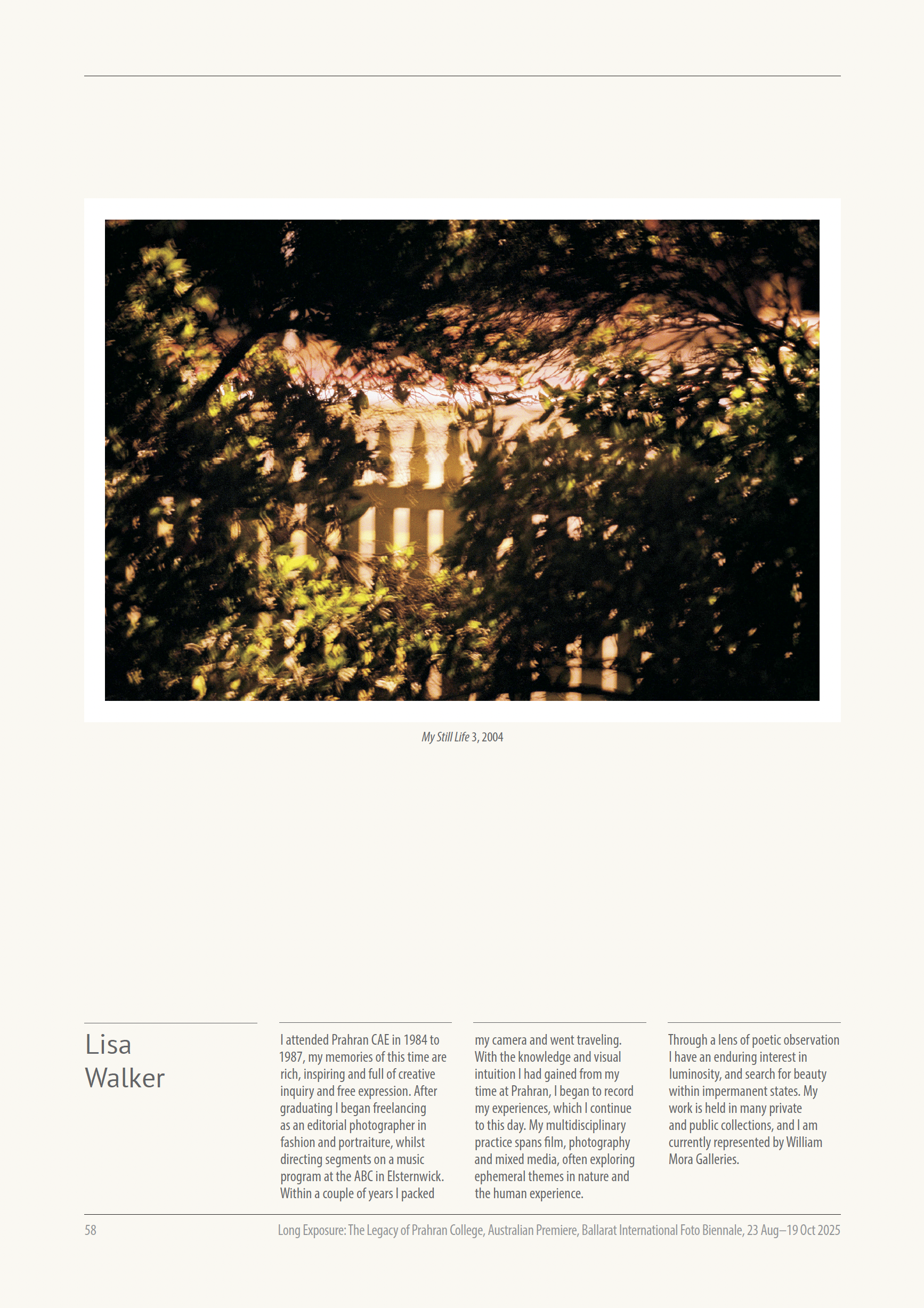
These 2017/18 works Walker shows in our Long Exposure: The legacy of Prahran College for the Ballarat International Foto Biennale, the regional city for which she made Slow Curtain for White Night, a projection cast onto the heritage facades.


That year she also reprised her fascination with fashion and the portrait in her 2024 solo exhibition Orchids for Eyes, fabric-textured monochrome collage works at William Mora Galleries which represents her.


Never fixed on one genre, Lisa’s focus is on reaching for, and encapsulating, an evanescent and fugitive beauty.
Walker has collaborated with performing arts groups The Australian Ballet, Chunky Moves, and the Melbourne Symphony Orchestra, and contributed editorial projects for Vogue, Belle, Rolling Stone, and The Age. Her work is held in collections the Art Bank, the City of Port Phillip, and private collections across Australia and the UK.
 Prahran Photography
One thought on “The Alumni: Lisa Walker”